
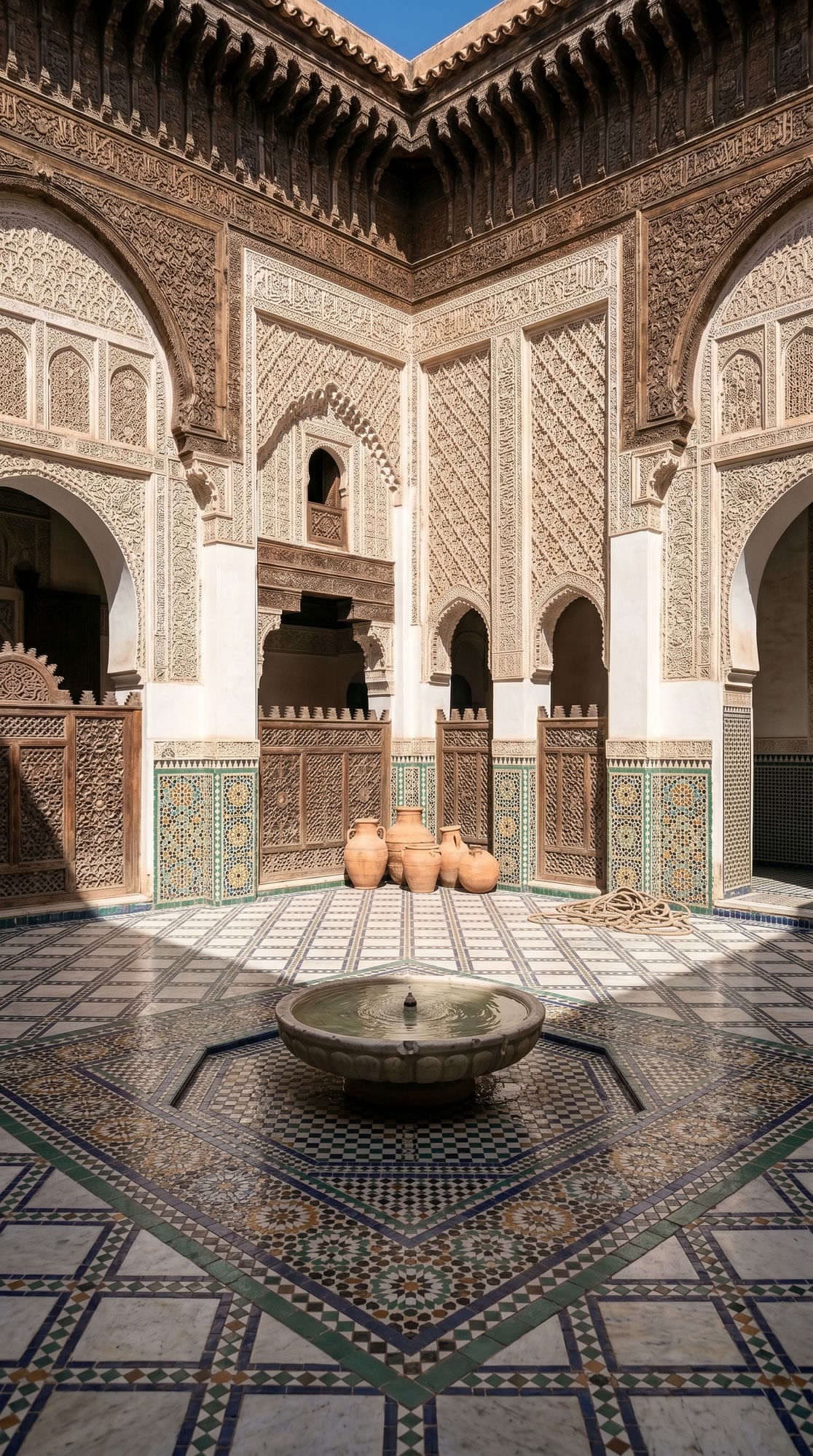
The area open to visitors in Bahia Palace covers roughly 8,000 square meters across more than 150 rooms, and most visitors walk through it in a vague loop, unsure of what they're looking at or whether they've seen everything. This guide solves that problem. Here's exactly what you'll encounter, section by section, and what's worth slowing down for in each one.
Key Takeaways
- Bahia Palace has no furniture. Grand Vizier Ba Ahmed died in 1900 and Sultan Abdelaziz stripped everything overnight. What you see is the architectural shell: zellige, carved stucco, painted cedar, and marble. Understanding this before you arrive turns the emptiness into part of the story.
- The palace has no strict symmetry and no single correct route. It was built in phases over decades without a master plan. Getting slightly disoriented is normal. Follow the signs, but don't worry about missing rooms: the natural flow takes you through all the major sections.
- Two things most visitors rush past: the painted ceilings (they look up briefly and move on) and the stucco inscriptions (bands of Quranic calligraphy carved high on the walls). Both reward the visitors who stop. Budget 90 minutes minimum. See the first-visit tips guide for how to structure your time.
What Should You Notice at the Main Entrance?
You enter through heavy wooden doors on Rue Riad Zitoun el Jedid. The entrance corridor is deliberately understated: narrow, cool, and dimly lit after the bright street. This is intentional — it makes the first courtyard you step into feel dramatically more spacious than it would otherwise.
What most visitors miss at the entrance: the door itself. The ironwork studs and carved wooden frame on the main gate are examples of traditional Moroccan metalwork and carpentry that predate anything inside. Look at the scale of the hinges and the weight of the wood. The entrance corridor also has its first painted ceiling panel above you — most people are looking ahead and miss it entirely.
Photography: A close shot of the door ironwork pattern in morning light, with the carved wood frame visible, is a strong detail shot that most visitors skip in their rush to reach the courtyard.
What Is the Small Riad and Why Does It Matter?
The first courtyard you enter is the older section — built by Si Moussa in the 1860s before Ba Ahmed's expansion. It's smaller and more intimate than what comes later, which makes it a useful reference point: this is what the palace was before Ba Ahmed made it one of the largest private residences in Morocco.
The proportions here are different. The stucco work is slightly less elaborate than in Ba Ahmed's later additions, but the zellige tiling on the floor is in excellent condition. The rooms opening off this courtyard were originally private domestic quarters, not formal reception spaces. The difference in scale between this section and the Grand Riad that follows is one of the most effective architectural contrasts in the palace.
Photography: The smaller scale means you can get the entire courtyard in frame from the doorway. Good for establishing the intimate feeling before you hit the grand spaces.
What Makes the Grand Riad the Heart of the Palace?
This is the centrepiece of the palace, and the space that stops most visitors mid-step. The Grand Riad covers approximately 1,500 square meters: a vast open courtyard paved with polychrome zellige tilework and framed on all sides by a painted wooden gallery supported by ornamental columns. Orange and lemon trees planted in geometric arrangements fill the courtyard with shade and scent. A central marble fountain marks the axis.
What to notice carefully:
- The painted wooden gallery ceiling: each panel is unique. Look at three or four in succession and you'll see that no two share the same pattern. The craftsmen from Fez who created these panels, documented by historical sources including Encyclopaedia Britannica, worked on each one independently
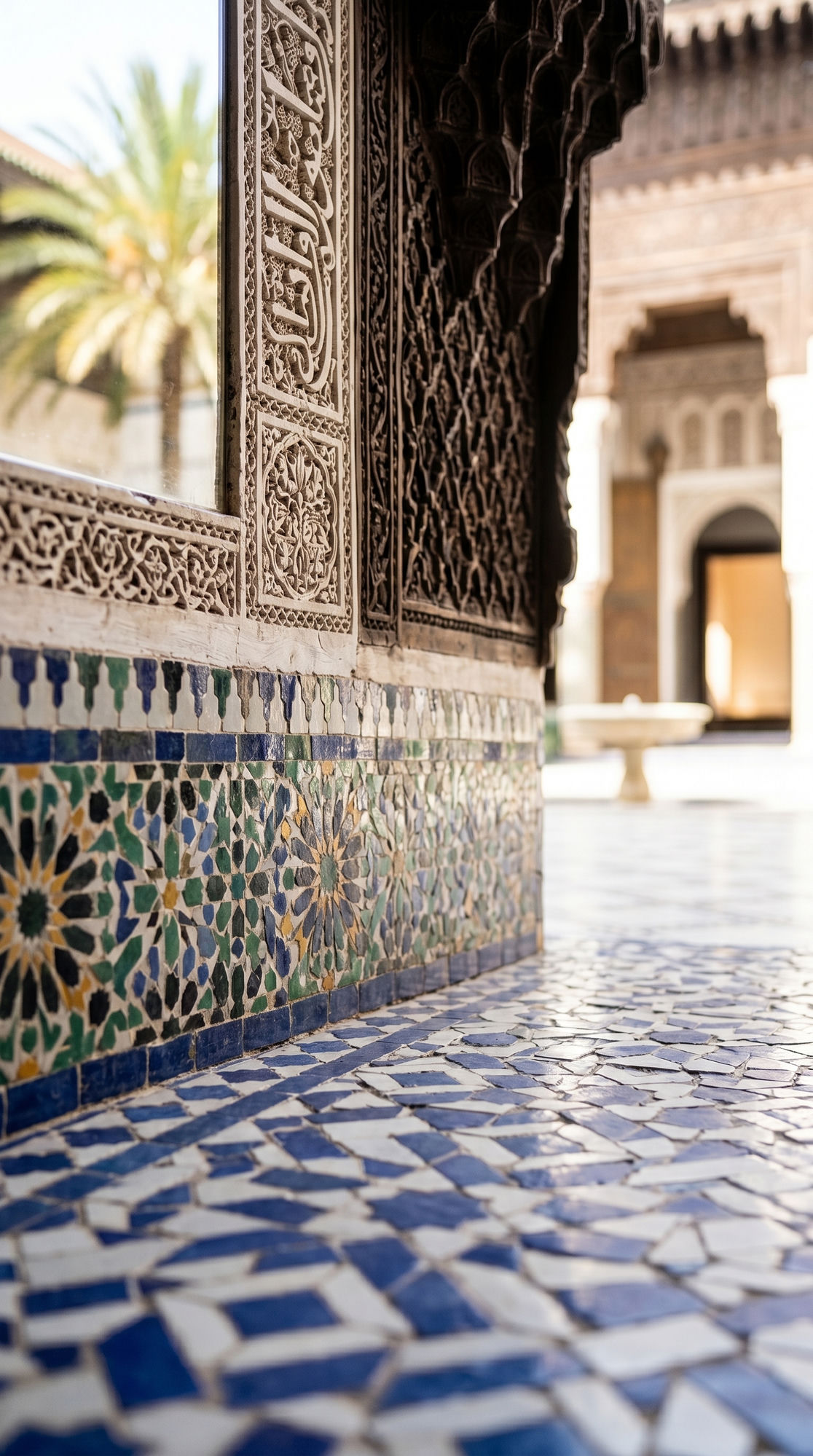
- The zellige floor pattern: geometric Islamic tilework that creates an optical depth effect when viewed from a low angle. The polychrome sections in the Grand Riad are the most complex in the palace
- The marble columns: Italian Carrara marble, imported specifically for this courtyard as a statement of Ba Ahmed's reach and resources
- The scale: 1,500 square meters is roughly the size of three tennis courts end to end
In our experience, visitors who spend 10 minutes in the Grand Riad on a careful first look understand the palace far better than those who cross it quickly. This courtyard is the architectural argument that everything else in the palace is a footnote to.
Photography: Best shot from the south end looking toward the north arcade. Early morning (9:00 to 10:30 AM) gives you the angled light that makes zellige look three-dimensional. See the photography guide for the specific positions and light windows.
What Did the Great Court Reveal About Ba Ahmed's Power?
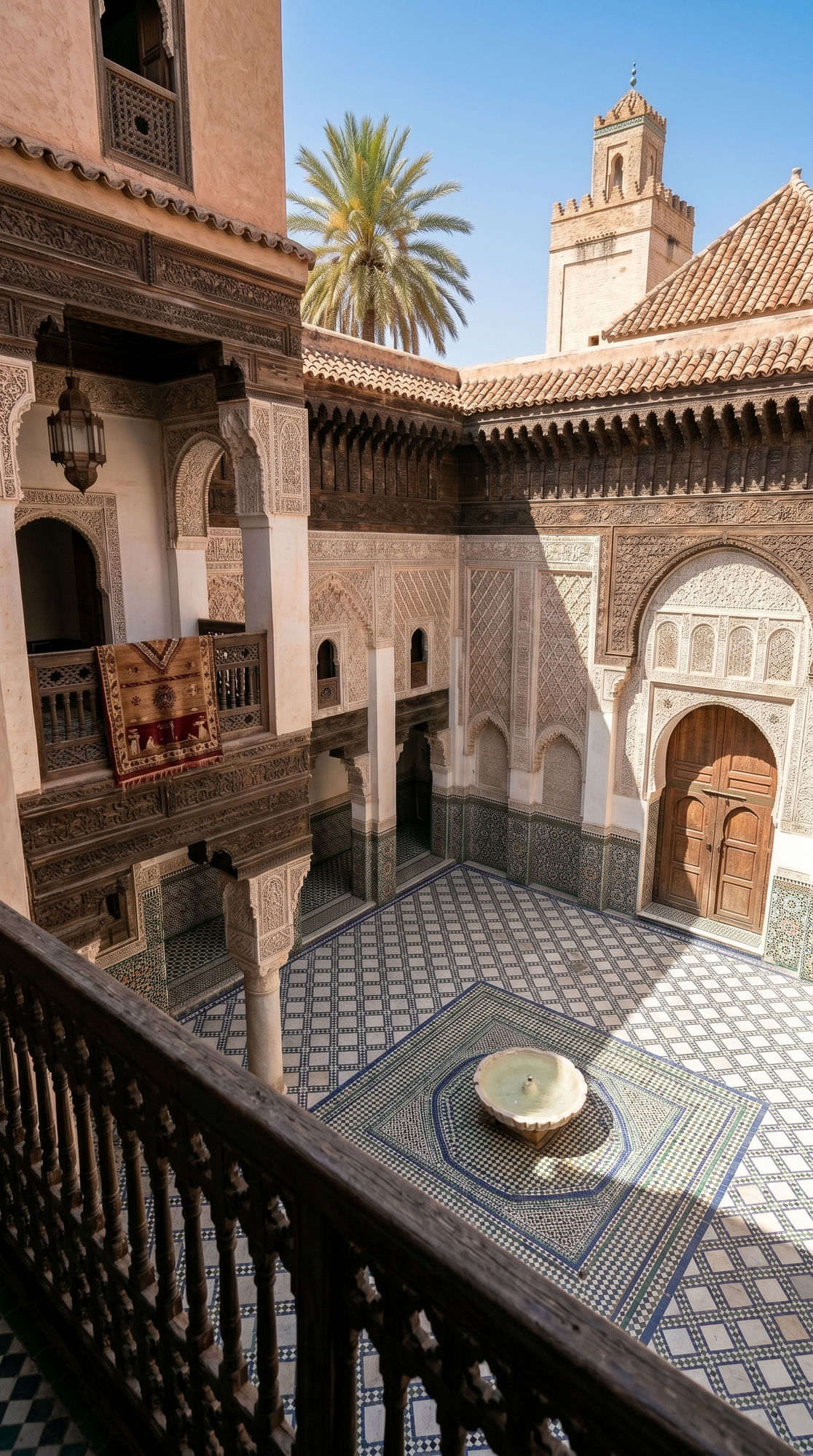
Beyond the Grand Riad, a series of interconnected courtyards and reception rooms form what's often called the Grande Cour, or Great Court. These were Ba Ahmed's formal reception spaces: where he met petitioners, hosted dignitaries, and exercised his authority as grand vizier and regent of Morocco between 1894 and 1900. Under Hassan I he had been hajib, chamberlain, not vizier.
The Council Room (Salle du Conseil) has the palace's most elaborate painted ceiling — a dense geometric composition in deep blues, reds, and gold that covers the entire surface. Stand directly below it and look straight up. Most visitors glance from the doorway; you need to be underneath to appreciate the full scale of the work. This was the room where Ba Ahmed made decisions affecting the lives of millions of Moroccans. The ceiling was built to communicate that power without words.
The carved stucco panels in these rooms are at their most intricate: arabesque plasterwork carved so finely it looks like lacework. The upper walls in several rooms feature bands of Arabic calligraphy that contain Quranic verses — placed at a height most visitors don't naturally look at. Bahia Palace lies within the UNESCO World Heritage Site of the Medina of Marrakesh (inscribed 1985, UNESCO World Heritage List, entry #331), and the carved calligraphy in the stucco is one of the features UNESCO specifically notes in the site's documentation.
What Can the Harem Quarters Tell You About Life Inside the Palace?
Ba Ahmed's four wives and 24 concubines occupied these private apartments, arranged in a deliberate hierarchy. The first wife's rooms are closest to the Grand Riad: the most prestigious position. Further from the main court means lower rank. The layout tells a social story that is legible once you understand the principle: architecture as power, and as control.
What to notice:
- The rooms here are smaller and more intimate than the formal reception spaces. The scale shifts from grand to human — these were living rooms and private courtyards, not stages.
- Some rooms retain their original painted tile dados (lower wall panels) in excellent condition. The colour choices and pattern complexity vary between rooms in ways that reflect the different status of their occupants.
- The window grilles — carved wooden latticework called mashrabiya — filtered light and allowed the women inside to observe activity outside without being seen. This was both practical privacy and social control.
Photography: The narrow corridors between rooms create natural leading lines. The mashrabiya windows project geometric light patterns onto the floor in late morning: position yourself to catch this between 9:30 and 11:00 AM. For the full hidden story behind these rooms, the hidden details guide covers what most visitors miss.
Why Are the Palace Gardens Worth Slowing Down In?
The palace gardens extend behind the formal rooms and are among the most peaceful spaces in the entire Medina. Planted with jasmine, roses, banana trees, orange and lemon trees, and cypress, they're a genuine retreat from the pace of Marrakech outside the walls.
The garden layout follows traditional Islamic design principles: a central axis, geometric planting beds, shade from tall trees, and a fountain as the focal point. The four geometric sections of the garden represent the four rivers of paradise described in Islamic scripture. In spring (March through April), jasmine and roses are in bloom and the scent is remarkable. The seasonal visit guide covers what to expect in the garden month by month.
Most visitors spend five minutes in the garden and leave. If you sit here for fifteen minutes and let the medina noise disappear, you get a very different experience of the palace. In our experience, the visitors who enjoy Bahia Palace most are those who slow down in the gardens rather than ticking off rooms and rushing to the exit.
Photography: The contrast of warm terracotta walls against lush green is excellent in late afternoon when the light turns golden. The doorways from the garden looking back into the covered rooms make strong compositional frames — bright outdoor green against cool shadowed interior.
Frequently Asked Questions
How many rooms does Bahia Palace have?
Bahia Palace contains approximately 150 rooms across its various sections — grand reception halls, formal courtyards, private apartments, service rooms, and garden pavilions. Not all rooms are open to the public at any given time. Some sections are occasionally closed for restoration work. The Ministry of Culture manages access (e-services.minculture.gov.ma).
Is the furniture original at Bahia Palace?
No. When Ba Ahmed died in 1900, Sultan Abdelaziz ordered everything moveable seized immediately. All furniture, carpets, textiles, silver objects, and decorative items were removed within hours of Ba Ahmed's death and taken to the royal treasury. What remains is only the fixed architecture: tilework, carved plasterwork, painted ceilings, and structural elements. The rooms are beautiful but empty. The full account is in the history article.
How long does it take to see the whole palace?
A thorough visit — every open section, including the harem quarters and gardens — takes 75 to 90 minutes. Visitors who rush through the main courtyards and miss the further sections typically spend 30 to 45 minutes and leave feeling they've missed something. Budget 90 minutes and you won't feel rushed. To go deeper, the audio guide overview covers whether guided context is worth adding to your visit.
Do I need to book a ticket in advance?
Walk-in tickets are available at 100 MAD (foreign adult price), but in peak season (March through November) the door queue can run 30 to 45 minutes. Booking online skips this entirely and is strongly recommended. See the entrance fee guide for children's rates, discounts, and how to buy.