
Most visitors walk through Bahia Palace knowing only that it's old and beautiful. The actual story is far more interesting, and considerably darker. It involves a man whose grandfather was owned as a slave, and who himself became the most powerful person in Morocco, built the greatest private palace the country had ever seen, and died knowing the Sultan had been waiting years to destroy everything he'd built.
- Bahia Palace was built 1894–1900 under Grand Vizier Ba Ahmed ibn Moussa. The roughly 8,000 m² open to visitors today is what survived after the palace was stripped of all its contents overnight in May 1900.
- Ba Ahmed’s grandfather was enslaved, owned by Sultan Moulay Slimane, and rose to become his chamberlain. Two generations later Ba Ahmed was the de facto ruler of Morocco for six years while the young Sultan Abdelaziz came of age. His palace was an act of deliberate display — and everyone in the court understood it as such.
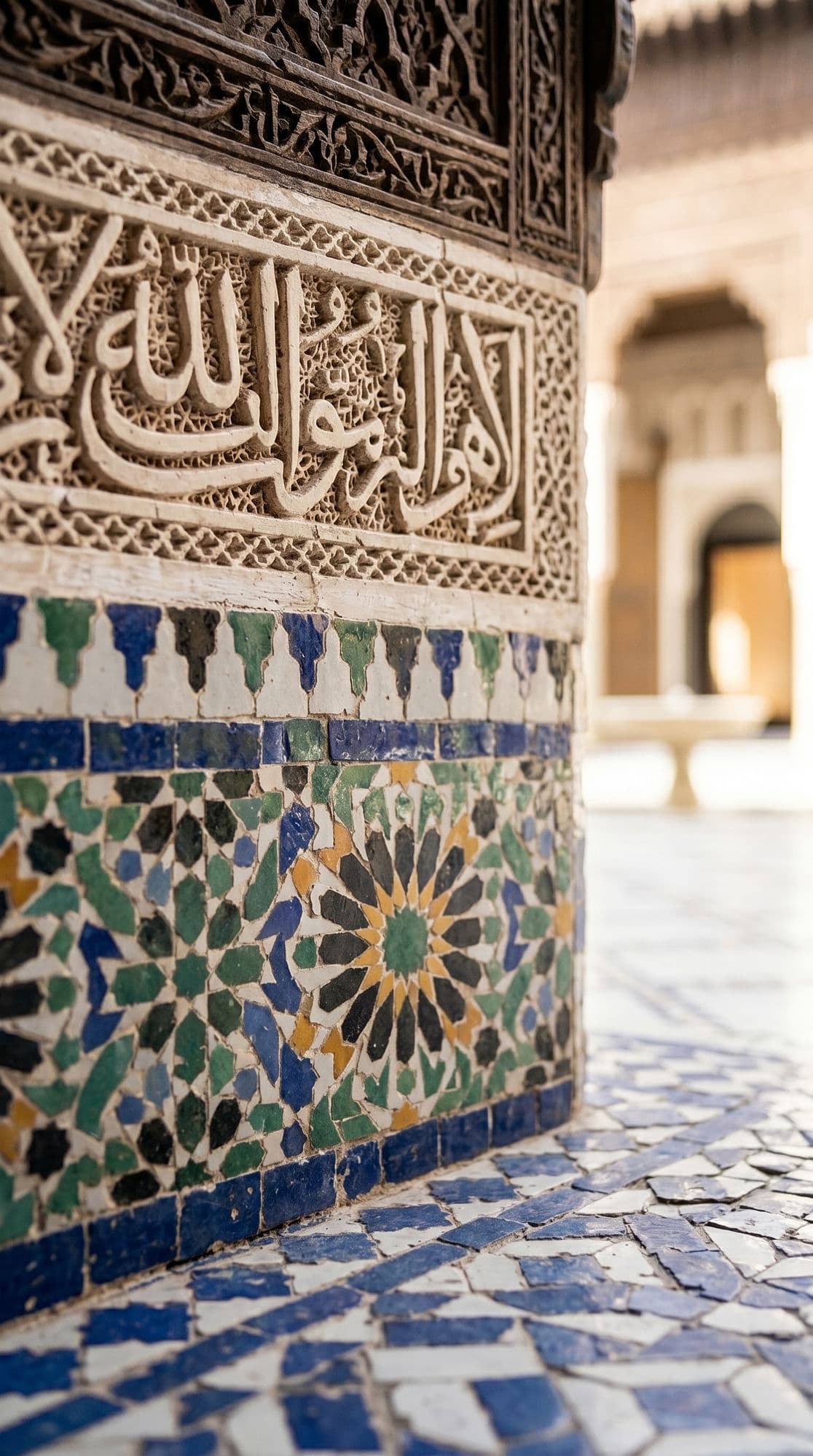
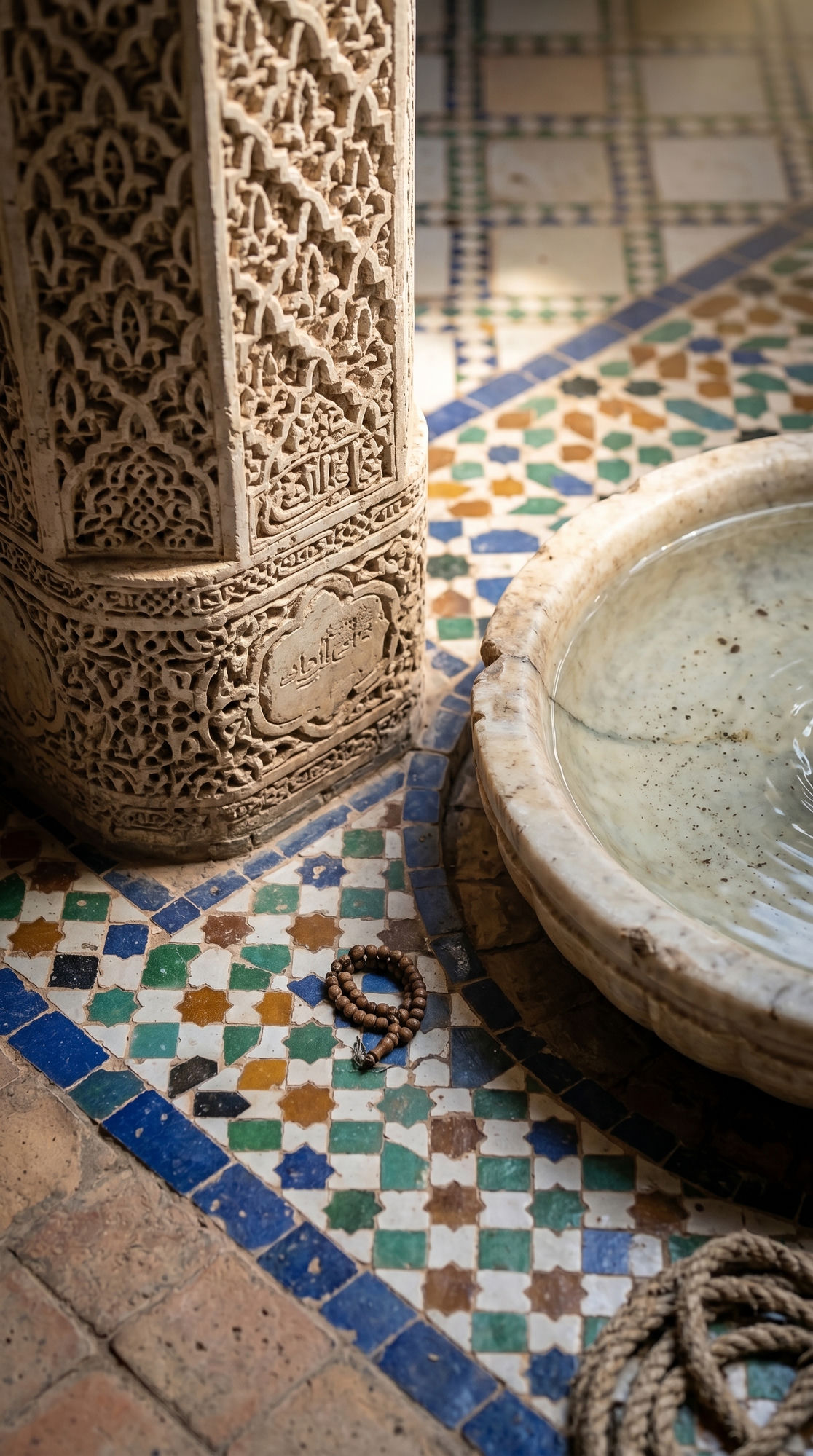
- The craftwork was executed by Fez-trained maalmin, the master craftsmen who held the highest reputation in Morocco for zellige, carved plaster and cedar joinery. The painted cedar ceilings, hand-cut zellige floors, and carved plasterwork are in near-original condition more than 125 years later.
- "Bahia" (الباهية) means "The Brilliant" in Arabic — a name Ba Ahmed chose himself, an act of brazen confidence for a man who was technically a servant of the Sultan.
Who Was Si Moussa?
The palace's origins begin with Si Moussa, born into a family that had entered the Moroccan court through slavery a generation earlier: his own father had been owned by Sultan Moulay Slimane and freed into the post of hajib, chamberlain. Si Moussa served Sultan Muhammad IV as hajib in turn, and later became Grand Vizier under Hassan I.
In the 1860s, Si Moussa began construction of a private residence in the southern medina of Marrakech. The first phase was relatively modest by royal standards: a riad with stuccoed rooms and a private garden. But the quality of the craftwork was exceptional — Si Moussa commissioned tilemakers, woodcarvers, and plasterwork specialists from Fez, then Morocco's artistic capital.
He named the residence Dar Si Moussa — the house of Si Moussa. It would later be renamed entirely by his son.
How Did Ba Ahmed ibn Moussa Rise to Power?
Ba Ahmed ibn Moussa was born in 1841–42 in Marrakesh, into a family already established at court. He inherited his father's wealth, but not his office: the vizierate was not heritable. Ba Ahmed entered the household of Sultan Hassan I as hajib in 1879 and spent fifteen years building a position of his own.
Under Sultan Hassan I, Ba Ahmed consolidated power through a combination of diplomatic skill, ruthlessness, and an extraordinary ability to manage competing interests within the Makhzen — the royal court. When Hassan I died suddenly in 1894 during a military campaign, reportedly with Ba Ahmed hiding the Sultan's death for days to prevent chaos, Ba Ahmed became the de facto regent for the young Sultan Abdelaziz, who was only 14 years old.
For the next six years, Ba Ahmed was Morocco. He controlled appointments, finances, foreign relations, and the military. Foreign governments dealt with him rather than the Sultan. He was not a member of the royal Alaoui family and held no hereditary title — everything he had came with the office of Grand Vizier, and left with him when he died. Gaston Deverdun’s Marrakech: des origines à 1912 (1959) remains the standard account of the period in the city.
How Was Bahia Palace Built?
With absolute power came the resources and inclination to build on an entirely different scale. Ba Ahmed took his father's modest riad and expanded it into something Morocco had never seen from a private individual.
He could not build a palace in the royal tradition — that was reserved for sultans. But the distinction between a "residence" and a palace can be managed by scale and craftsmanship, and Ba Ahmed managed it. The result runs to roughly 150 rooms across nearly two hectares of building, set in grounds of eight hectares once the agdal garden is counted. Deverdun records that Ba Ahmed assembled the site by absorbing the plots of some sixty neighbouring houses and acquiring sixteen gardens.
The construction ran from 1894 until approximately 1900 and involved:
- Master craftsmen (maalmin) from Fez — Fez-trained specialists held the highest reputation in Morocco for zellige mosaic tilework, carved plaster, and cedar joinery. Ba Ahmed wanted the best available, and he could afford to import them.
- Italian Carrara marble imported for the most important reception rooms
- Hand-carved cedar ceilings with intricate muqarnas plasterwork painted with mineral pigments that have barely faded in 125 years
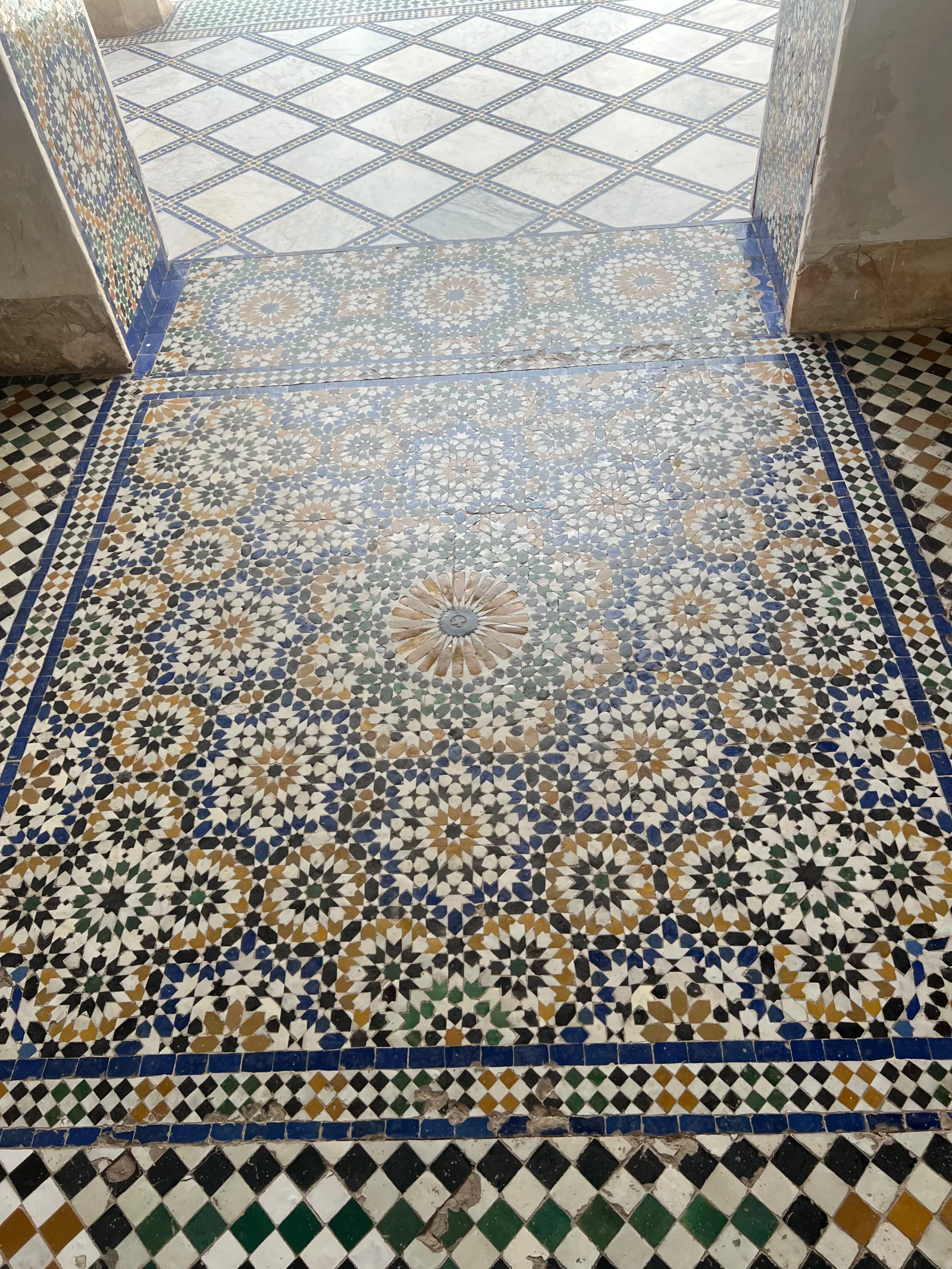
- Zellige tilework covering floors and lower walls across dozens of rooms, each tile cut and placed by hand
- Around 150 rooms across multiple courtyards, including grand reception halls, private apartments, harem quarters, and staff areas — explored in detail in the room-by-room guide to Bahia Palace
- Gardens planted with orange, lemon, cypress, jasmine, and roses
Each material was sourced from its most respected origin. The zellige tiles were fired in Fez kilns and transported by mule train to Marrakech — a journey of several days. The limestone for the carved plaster panels was quarried locally from the Haouz plain south of the city. Cedar beams came from the Middle Atlas forests east of Marrakech. The result is a building that has held up extraordinarily well: most construction in the Marrakech medina requires significant restoration every generation, but Bahia Palace needs far less intervention because the materials were chosen for permanence, not economy.
The interplay of light and shadow in the courtyards, the sound of fountains, and the fragrance of orange trees are as deliberate as any architectural feature. The palace was designed as a total sensory experience.
What Does "Bahia" Mean in Arabic?
"Bahia" (الباهية) is an Arabic word meaning "The Brilliant" or "The Radiant." The feminine form is significant — it applies the brilliance to the palace itself rather than its owner: the brilliant one, the radiant thing. Ba Ahmed chose this name himself while construction was underway, which was unusual. Most Moroccan palaces were named by later residents, historians, or by their location. Ba Ahmed named his while he was alive to see it built.
The name also carried political weight. In the context of the Moroccan court, "brilliance" implied divine favour and excellence of character, not just wealth. By naming his residence "The Brilliant," Ba Ahmed was making a claim about himself that stopped just short of royal language. It was a statement — and everyone in the court understood it as such.
What Was Life Like Inside Bahia Palace?
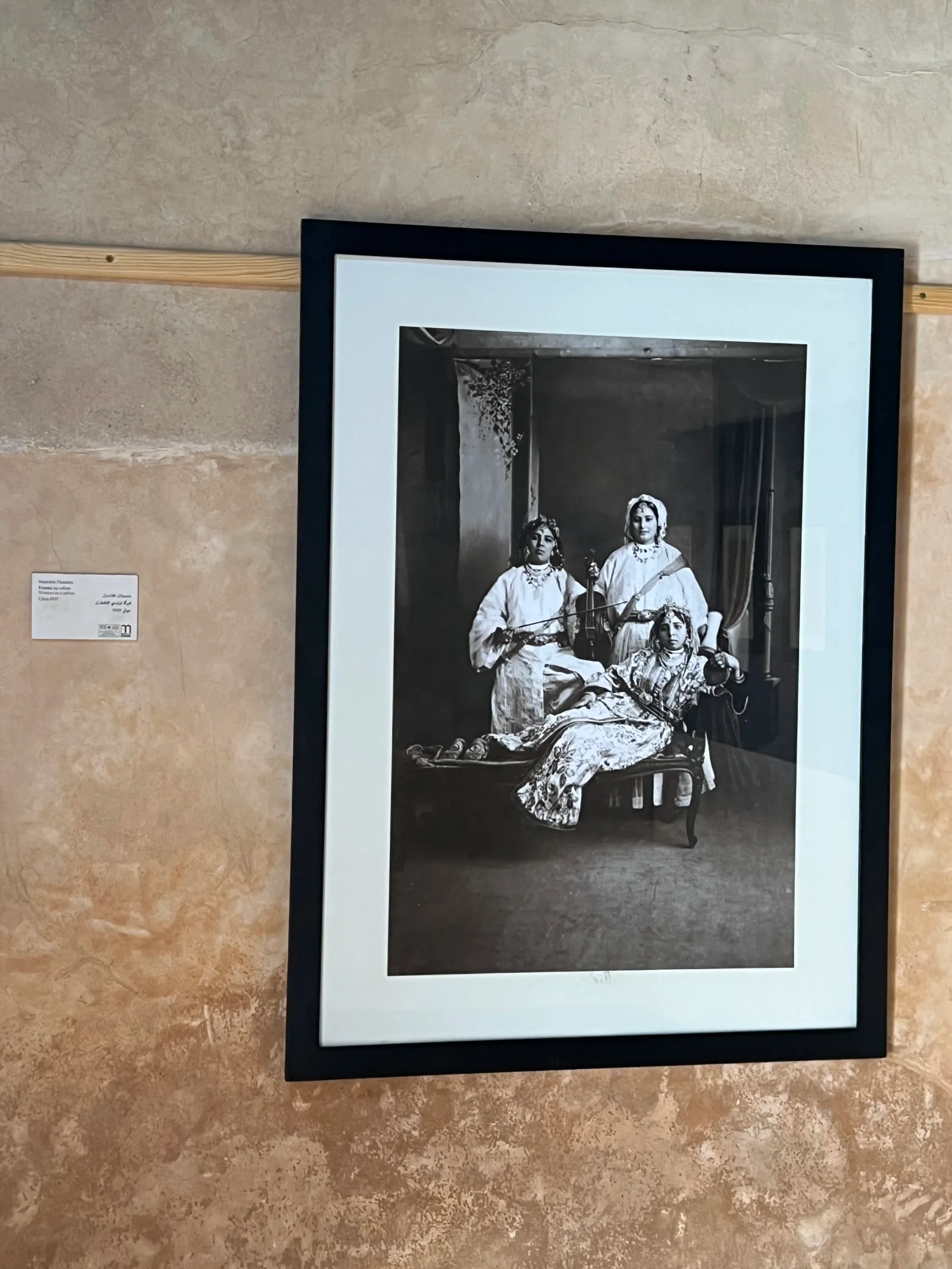
Bahia Palace at its height was a complete world. Ba Ahmed lived there with four wives, each with their own apartment ranked in order of precedence: the first wife's rooms were closest to the Grande Cour, with access to the Grande Salle d'Honneur for formal receptions. The harem quarters housed 24 concubines. Hundreds of servants, guards, cooks, and officials completed the household.
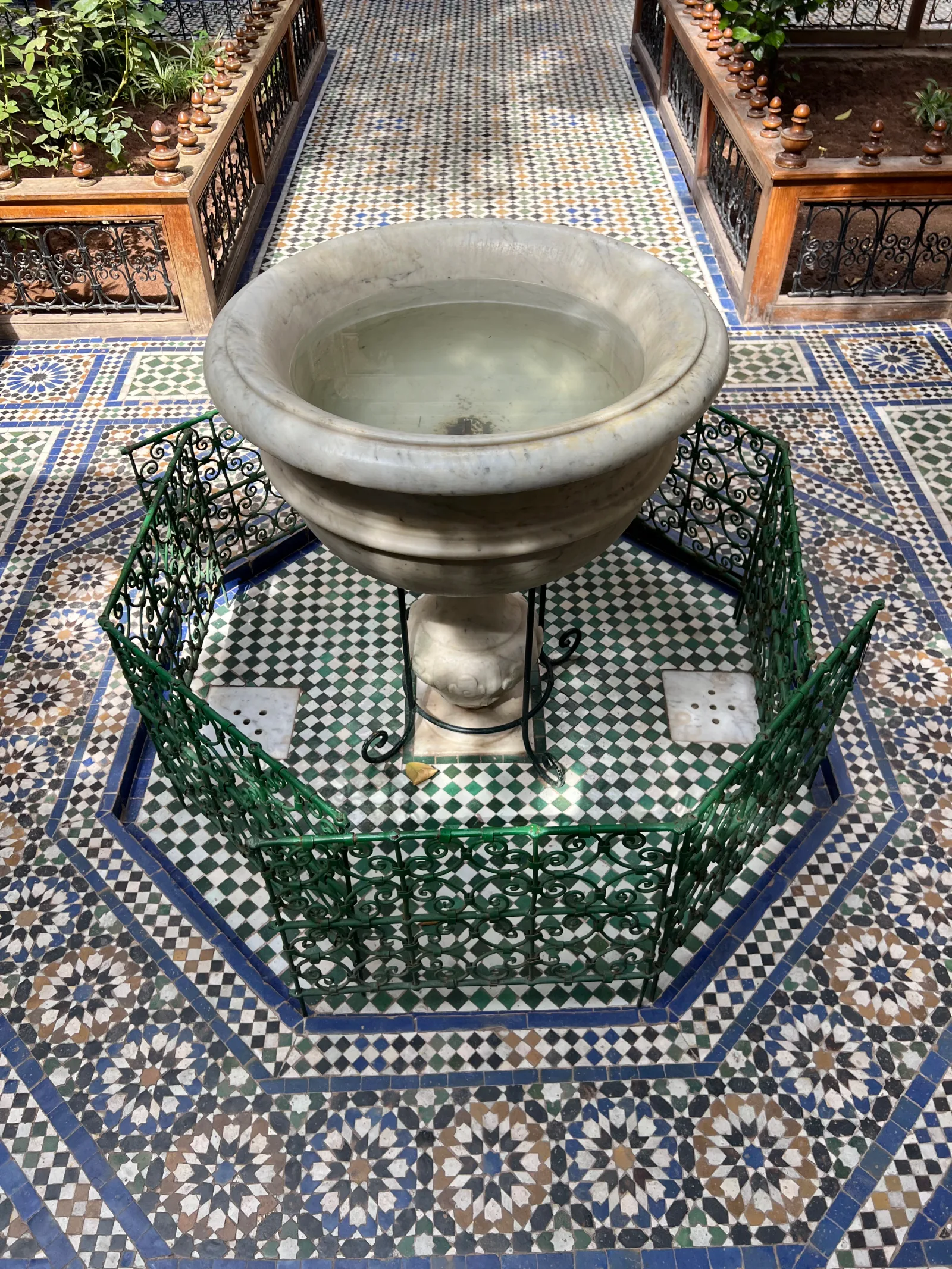
There was also a practical dimension to the scale. Ba Ahmed's household required the kind of spatial separation that only a building this large could provide. Each section of the harem had its own fountain and orange-tree courtyard. What reads as extravagance was also functional.
When I walk through the harem courtyard in the late afternoon, the light comes through the orange trees at an angle that turns the zellige tiles amber from inside. I have been here more than a dozen times and I still slow down at that courtyard. The orientation is not accidental — the harem wing catches afternoon shade while the official reception rooms face morning light. Ba Ahmed's architects planned sun exposure by function and by occupant.
Foreign ambassadors, merchants, and petitioners came to Bahia Palace to seek the Grand Vizier's audience. Ba Ahmed held court here, received gifts, conducted negotiations, and exercised power from within these walls. The Grand Riad, the vast central courtyard covering 1,500 square metres, was where formal receptions took place. The smaller courtyards and rooms were private. The distinction was deliberate: architecture as a tool of power, controlling who could see what and how far into the complex they were permitted to enter. A guided tour of Bahia Palace can reveal layers of this hierarchy that are invisible to unaccompanied visitors.
What Happened When Ba Ahmed Died in 1900?
Ba Ahmed ibn Moussa died in May 1900, at the peak of his power. He had spent his final years knowing that Sultan Abdelaziz, now old enough to rule independently, resented his regent's dominance. The relationship between them had become openly hostile.
The consequences were immediate and total. Within hours of Ba Ahmed's death, the Sultan's soldiers entered Bahia Palace. Over the following days, everything moveable was seized and distributed: furniture, carpets, silver and gold objects, artworks, textiles, mirrors, and musical instruments. Ba Ahmed's family was expelled. The palace became crown property by the standard Makhzen convention that a Grand Vizier's estate reverted to the sultan on death.
What they couldn't take were the walls, the floors, the ceilings, and the gardens. The zellige, the carved stucco, the painted cedar — these were built in. The architectural shell of Bahia Palace survived intact; everything that had filled it was gone.
I have stood in the empty grand reception room where Ba Ahmed would have received foreign ambassadors and provincial governors. It covers roughly 900 square metres of painted cedar ceiling and zellige floor with nothing in it at all. That emptiness is not neglect. The palace looked exactly like this within a year of Ba Ahmed's death. The decoration survived because it could not be moved. Ba Ahmed's architectural ambition outlasted his political legacy by the simple fact that carved cedar cannot be packed into a cart.
Ba Ahmed spent six years building a palace designed to last centuries. He was dead within months of its completion. The sultan who had depended on him for governance his entire life ordered the palace stripped before Ba Ahmed's household had time to grieve. The architecture survived intact. The man's legacy is more complicated: remembered now mainly through the building he could not take with him.
What Happened to Bahia Palace Under French Rule?
When France established its protectorate over Morocco in 1912, Bahia Palace became the official residence of the Resident-General, France's representative and effective ruler of the country. Generals Lyautey and Noguès both lived here.
The French made modifications, including plumbing, electrical work, and minor structural changes, but largely preserved the palace's architecture. Photographs from the French period show the rooms still empty of the original furnishings but otherwise intact.
After Moroccan independence in 1956, the palace passed to the Moroccan state and was gradually opened to the public. It has been managed as a protected heritage monument since the 1960s, overseen today by Morocco's Ministry of Culture (e-services.minculture.gov.ma).
Bahia Palace Today
What you see when you visit Bahia Palace is essentially what Ba Ahmed built between 1894 and 1900, minus everything that could be carried out. The architecture is in remarkable condition given its age: the painted ceilings retain their colour, the zellige tilework is largely intact, and the gardens continue to be maintained.
Bahia Palace lies within the Medina of Marrakesh, inscribed on the UNESCO World Heritage List in 1985 (UNESCO World Heritage List, entry #331). Restoration work is ongoing — sections are occasionally closed when scaffolding is needed for ceiling or plasterwork repair.
It is one of the most visited monuments in Morocco: 410,141 people came through between January and April 2019, the most recent period for which a figure has been published. No official annual total is released, and the "500,000 a year" widely quoted online is an estimate. Check current Bahia Palace opening hours and the entrance fee before your visit, as both vary during Ramadan.
See It for Yourself
Understanding the history makes everything you see inside the palace more meaningful. Before your visit, consider reading about Ba Ahmed or using the audio guide available at the entrance. Book your ticket in advance and walk in ready to understand what you're looking at — not just that it's beautiful, but why it exists and what happened to it.
Visitor Tips
- Look up: the painted cedar ceiling of the Grande Salle d'Honneur is the highlight of the palace.
- The inner garden (riad) is most beautiful in spring when the orange trees bloom.
- The harem section has the most intimate and intricate decoration. Don't rush through it.
- A licensed guide can reveal hidden details invisible to unaccompanied visitors. The guided tour guide covers what to ask and what to look for.
Frequently Asked Questions
Who built Bahia Palace?
The palace was built in two phases. The original structure was built by Si Moussa, chamberlain to Sultan Muhammad IV and later Grand Vizier under Hassan I. The two chambers flanking the garden carry an inscription dating them to 1866–67, the earliest firm date on the building. His son Ba Ahmed ibn Moussa massively expanded it between 1894 and 1900, transforming it into a complex covering roughly 8 hectares in total, with around 8,000 m² open to visitors today.
When was Bahia Palace built?
The main palace visible today was built between 1894 and 1900. Ba Ahmed began expanding his father's earlier residence when he became Grand Vizier in 1894. Construction continued until his death in 1900, and some historians note the final wing was not fully complete when he died. The earliest firm date on the site is 1866–67, carved into the two chambers flanking the garden of Si Moussa’s predecessor building.
What does "Bahia" mean?
"Bahia" (الباهية) is an Arabic word meaning "brilliance," "radiance," or "the brilliant one." The feminine form applies the quality to the palace itself. Ba Ahmed chose this name deliberately during construction — an unusual practice in Moroccan palace naming, which typically assigned names after the fact. It was a direct statement about the building's intended grandeur, understood by everyone in the court as an act of extraordinary ambition.
How many rooms does Bahia Palace have?
Bahia Palace has approximately 150 rooms arranged around six courtyards across 8 hectares of grounds. The southern wing contains the harem quarters designed for Ba Ahmed's wives and concubines, each section with its own courtyard, fountain, and garden. The northern section held the Grand Vizier's official reception rooms, offices, and guest quarters. Not all rooms are open to the public.
Why is Bahia Palace empty?
When Ba Ahmed died in May 1900, Sultan Abdelaziz — who had long resented Ba Ahmed's power as regent — immediately ordered soldiers to strip the palace. Furniture, carpets, artworks, silver, and all moveable objects were seized within days. Only the fixed architecture, the tilework, carved ceilings, and built-in plasterwork, could not be removed. The palace has been empty of its original furnishings ever since.
Who owns Bahia Palace today?
Bahia Palace is owned by the Moroccan state and administered by the Ministry of Culture. It operates as a national monument open to the public. The building is within the Medina of Marrakesh, inscribed as a UNESCO World Heritage Site in 1985 (entry #331). Occasional state visits use the palace's reception rooms, which remain royal property for official functions.
Sources
- Deverdun, Gaston. Marrakech: des origines à 1912. Rabat: Éditions Techniques Nord-Africaines, 1959.
- Wilbaux, Quentin. La médina de Marrakech: formation des espaces urbains d’une ancienne capitale du Maroc. Paris: L’Harmattan, 2001.
- Ghachem-Benkirane, Narjess & Saharoff, Philippe. Marrakech, demeures et jardins secrets. Paris: ACR Édition, 1990.
- Miller, Susan Gilson. A History of Modern Morocco. Cambridge University Press, 2013.
- UNESCO World Heritage Centre. "Medina of Marrakesh." World Heritage List, Inscription No. 331, 1985. whc.unesco.org/en/list/331
- Ministère de la Jeunesse, de la Culture et de la Communication (Maroc). "Palais Bahia", official ticketing. e-services.minculture.gov.ma