
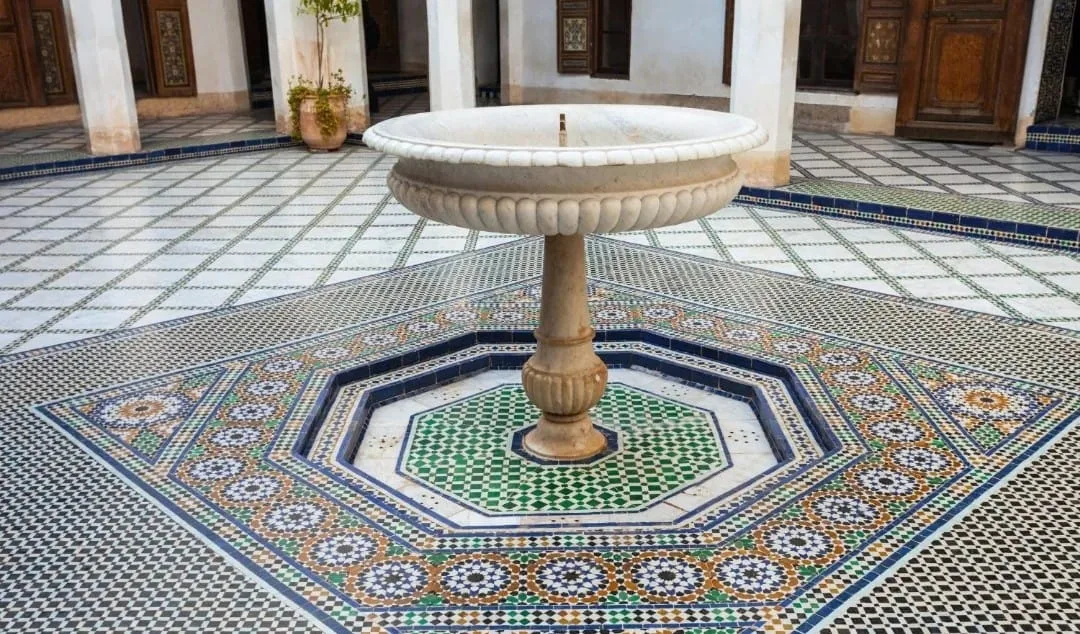
Stand in the main courtyard of Bahia Palace and look at the floor. Every one of those small coloured shapes was cut by hand, individually, with a hammer. Not pressed, not printed, not cut by machine. A craftsman held a glazed tile against a block and chipped it into a shape roughly the width of your thumbnail, thousands of times over.
That is zellige, and it is one of maybe six things you are looking at in this building without having a word for. This guide gives you the vocabulary and, more usefully, tells you exactly where inside Bahia Palace to find the best example of each.
What is zellige?
Zellige is hand-cut ceramic mosaic. Glazed tiles are fired, then broken down into small geometric pieces called furmah, then assembled face-down into a pattern and backed with plaster. When the panel is turned over, you get the finished surface.
The pieces are cut with a sharp-edged hammer called a menqach, held against the tile at an angle. It takes years to learn. A master craftsman, a maallem, can cut shapes to a tolerance that looks machine-made from three metres away and is obviously handmade from thirty centimetres.
Two things make zellige recognisable:
The geometry is mathematical, not decorative. Patterns are built from repeating stars, usually with 8, 12, 16 or 24 points, radiating outward on a strict grid. The complexity comes from the geometry, not from the artist inventing shapes.
The colours are limited. Traditionally white, blue, green, yellow and a terracotta red-brown, all from mineral glazes. When you see a Moroccan tile panel with a wide modern colour range, it is usually not traditional zellige.
Where to see it at Bahia: the floors and lower walls of the main courtyard, and the dado band running around almost every interior room. The best single panel is usually on the lower wall of the grand courtyard, where the star pattern is largest and least interrupted.
Why is the pattern never perfectly symmetrical?
Look closely at any large zellige panel and you will find that the two halves do not quite match. A piece is fractionally wider here, a join fractionally thicker there.
Some of this is simply the reality of hand-cutting thousands of pieces. Some of it is said to be deliberate, on the principle that perfection belongs to God alone and a craftsman should not claim it. Accounts vary on how consciously that principle was applied at Bahia specifically, and you will hear guides state it more confidently than the evidence supports.
Either way, the practical effect is the same and it is the easiest way to prove to yourself that you are looking at handwork. Our 10 hidden details guide points out several specific panels where the asymmetry is visible without hunting for it.
What is zouak? The painted cedar ceilings
Look up. Almost every ceiling in Bahia Palace is painted cedar, and the craft is called zouak.
Cedar is imported from the Middle Atlas, cut into panels or coffers, and painted freehand with pigment in patterns of interlacing florals and geometry. No stencils. The painter works from memory and training, which is why two ceilings in the same building are related but never identical.
The colours you see now are muted. They were not originally. Fresh zouak is bright to the point of being loud, with strong reds, greens and gold. What you are looking at is more than a century of oxidation, smoke and light.
Where to see it at Bahia: the ceilings of the grand reception rooms, and the octagonal dome in the main salon. The domed ceilings are the showpieces, but the long coffered ceilings in the arcades are technically harder and often better preserved.
Photographing these is awkward because they are directly overhead and dimly lit. The photography guide covers how to handle it.
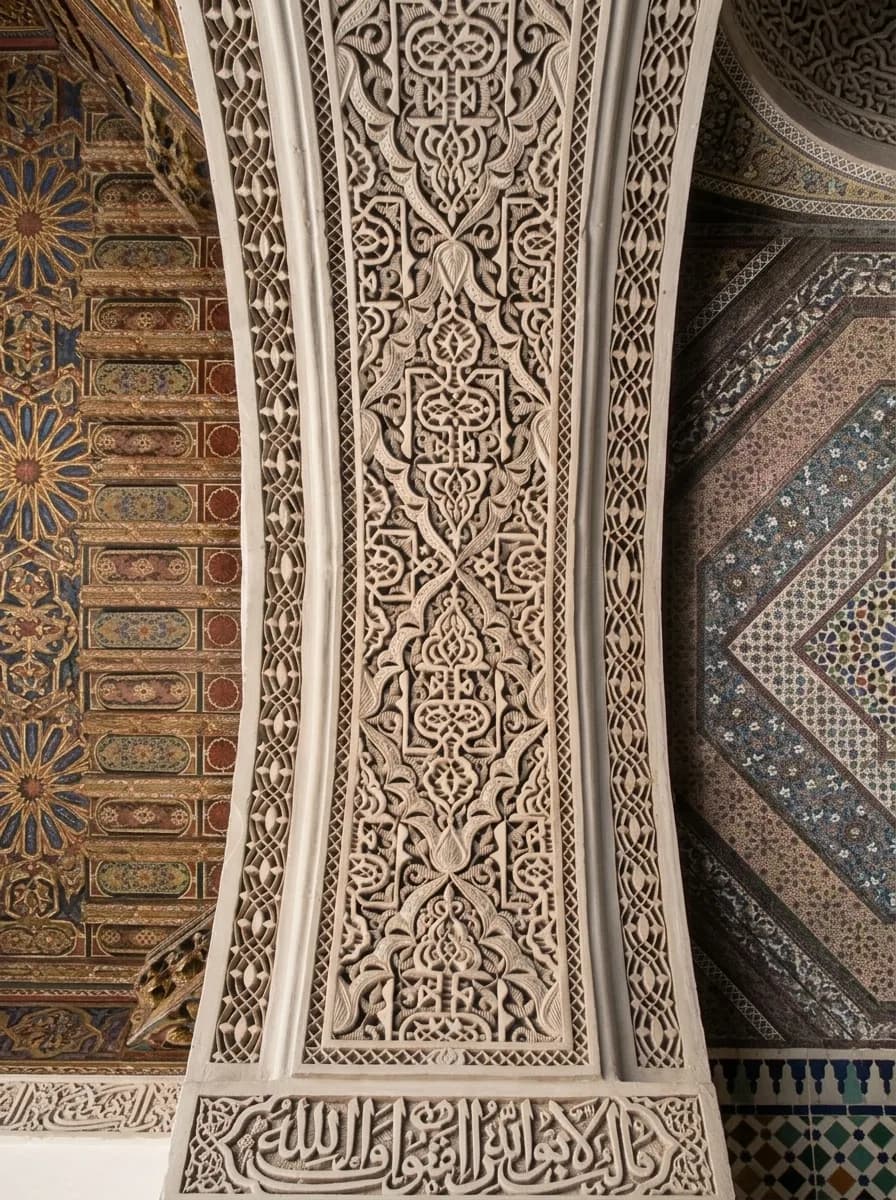
What is carved stucco, and what is gebs?
The white, lace-like carved plaster covering the upper walls is gebs, sometimes just called carved stucco.
Wet plaster is applied to the wall and, while it is still workable, carved by hand with fine tools. The craftsman is working against a clock: once it sets, the opportunity is gone. The patterns combine three vocabularies that repeat across Moroccan architecture:
- Geometric interlacing, related to the zellige below it
- Vegetal or arabesque scrollwork, stylised leaves and vines
- Calligraphic bands, usually Quranic verses or dedications in Kufic or cursive script
That vertical arrangement is not accidental. In most rooms at Bahia you get zellige at the bottom, carved plaster in the middle, painted cedar at the top. Hard, durable material where people touch the walls; lighter, finer work as you go up.
Where to see it at Bahia: the arches around the main courtyard, and the lunettes, the fan-shaped carved panels set above interior doorways. Several of the best are in the private apartments.
What is muqarnas?
Muqarnas is the honeycomb or stalactite vaulting you find tucked into corners, above doorways and inside domes. It looks like a cluster of small niches stacked in tiers, each one slightly offset from the one below.
Structurally, it solves a problem: how do you transition from a square room to a round dome without an ugly join? Muqarnas fills that corner with a cascade of small forms that steps the geometry across gradually. It is decoration doing engineering work.
It is also the hardest thing in the building to photograph and the easiest to walk under without noticing.
Where to see it at Bahia: in the upper corners of the grander rooms and above several of the main doorways. Look up at the corner where two walls meet a ceiling.
What is tadelakt?
Tadelakt is the smooth, seamless, slightly waxy plaster you see on walls that have no tile or carving at all, often in corridors, service areas and bathing rooms.
It is lime plaster polished with a stone and sealed with black soap, which makes it water-resistant and gives it that soft sheen. Traditionally it was used in hammams for exactly that reason. It has no joints, so there is nowhere for water to get in.
Modern designers have made tadelakt fashionable worldwide, usually in beige. In the medina it is often a warm ochre or a deep red, which is where a good deal of Marrakech's colour comes from.
Where to see it at Bahia: the narrow connecting corridors between courtyards. These passages get walked through quickly, which is a shame, because the contrast between a plain tadelakt corridor and the decorated room it opens into is a deliberate architectural effect. The plainness makes the next room land harder.
Riad, douiria, and how the palace is laid out
Two more words, and these are about plan rather than surface.
A riad is an interior garden courtyard, typically divided into four quadrants by paths crossing at a central fountain. The four-part division has a long history in Islamic garden design. A riad is enclosed, inward-facing, and invisible from the street, which is the organising principle of the whole medina: blank walls outside, everything inside.
A douiria is a small self-contained apartment within a larger house, often used for guests or for a branch of the family.
Bahia is essentially a collection of these units joined together. Ba Ahmed bought neighbouring properties between 1894 and 1900 and absorbed them, which is why the plan wanders instead of following one grand axis. The building is a sequence of courtyards and apartments rather than a single designed palace, and once you know that, the layout stops feeling confusing and starts feeling like a history of purchases. Our room-by-room guide walks the sequence in order.
The single-level design is worth noting too. Bahia has no upper floor, which is unusual for a building of this importance and has a practical consequence today: it is one of the more navigable monuments in Marrakech for anyone with limited mobility, as our accessibility guide sets out.
A short glossary
| Term | What it is | Where to look |
|---|---|---|
| Zellige | Hand-cut ceramic mosaic | Floors and lower walls |
| Zouak | Hand-painted cedar | Ceilings |
| Gebs | Carved plaster | Upper walls, above doorways |
| Muqarnas | Honeycomb vaulting | Corners, dome transitions |
| Tadelakt | Polished waterproof lime plaster | Corridors, bathing rooms |
| Maallem | Master craftsman | — |
| Riad | Interior four-part garden courtyard | The garden courtyards |
| Douiria | Small self-contained apartment | Private wings |
Why the empty rooms are the point
Most visitors are mildly disappointed that Bahia Palace has almost no furniture. The rooms were stripped after Ba Ahmed died in 1900, and what you walk through now is an empty shell.
Once you have the vocabulary above, that emptiness reads differently. There is nothing in the way. The zellige, the gebs, the zouak and the muqarnas are the entire content of the building, and you can see all four in a single glance up a wall. A furnished palace would hide half of it.
The story of how the palace was emptied is worth reading before you go, and the private family quarters are where the finest surviving surface work tends to be.
Frequently asked questions
What does zellige mean?
Zellige refers to hand-cut ceramic mosaic tilework, and to the individual glazed pieces used to make it. Each piece is chipped to shape by hand with a specialised hammer, then assembled face-down into geometric patterns before being backed with plaster.
What is the difference between zellige and regular mosaic?
Zellige pieces are cut to shape after firing, by hand, which lets craftsmen build precise geometric star patterns. Most mosaic uses pre-made square or standardised pieces. The hand-cutting is why zellige patterns can be so intricate and why no two panels are identical.
Is the zellige at Bahia Palace original?
Much of the surface work dates from the 1894–1900 expansion and is in remarkably good condition. Areas have been restored over the decades, as you would expect in a building this old, and restoration work is generally done using the same traditional methods.
What is the painted wood ceiling called in Moroccan architecture?
Zouak, the craft of hand-painting cedar. Painters work freehand without stencils, which is why related ceilings in the same building are never quite identical.
Can you touch the zellige?
Please do not. The lower panels are within easy reach and that is precisely why they wear. Oils from hands dull the glaze over time, and at this scale of visitor numbers small damage compounds quickly.
Where is the best zellige in Marrakech?
Bahia Palace has the largest accessible collection of late 19th-century work. For 16th-century craftsmanship in one concentrated space, Ben Youssef Madrasa is the other essential stop, and comparing the two periods side by side is genuinely instructive.
Bahia Palace is where most of these crafts sit within arm's reach of each other. Entry is the official 100 MAD, sold without added booking fees, and our ticket page explains how it works.