
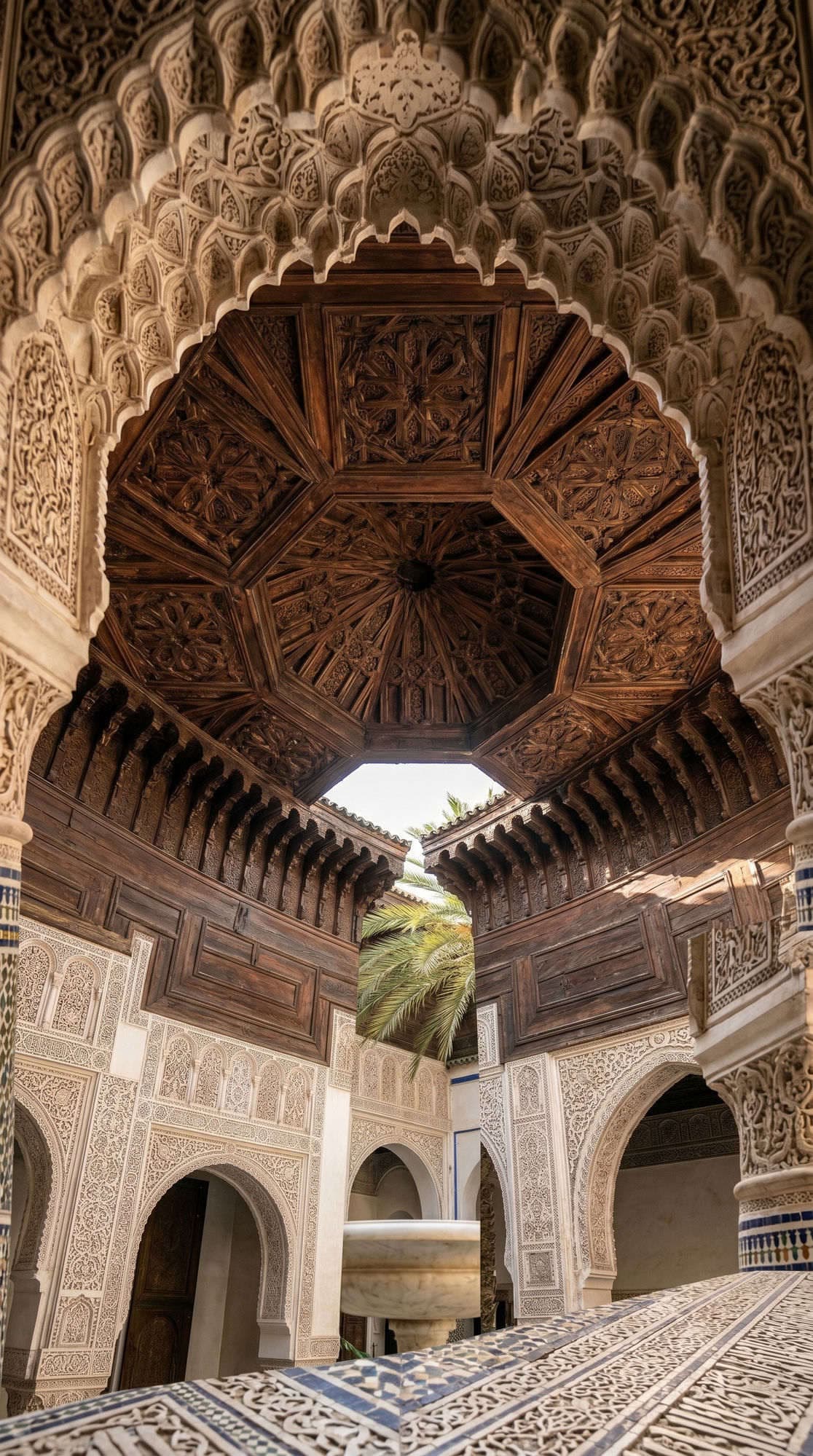
Bahia Palace is one of the most photogenic buildings in Morocco, and one of the most challenging to photograph well. The interiors are dim, the crowds arrive early, and the best angles take a few minutes to find. This guide gives you the exact information you need to come away with shots worth keeping.
Key Takeaways
- Best light: 9:00 to 10:30 AM. The Grand Riad faces roughly north-south and morning sun creates angled light that makes zellige look three-dimensional. After 11:00 AM, the same shot is flat.
- No flash. This is actively enforced by palace staff. Use your phone's Night Mode or a camera with a fast prime (f/1.8 or better) for interior rooms. The painted cedar ceilings are several centuries old and light-sensitive.
- You don't need professional equipment. A modern flagship phone handles all six photo spots covered below. The advantage of a dedicated camera is RAW files and better noise control in low light.
What Are the Photography Rules at Bahia Palace?
- Personal photography: fully allowed throughout the palace, no ticket or fee required
- Flash photography: strictly prohibited — the painted ceilings and pigmented plasterwork are light-sensitive; guards enforce this actively
- Drones: not permitted — inside or in the immediate vicinity
- Tripods: no official prohibition, but in crowded rooms guards may ask you to put them away; early morning visits are your best chance to use one without issue
- Commercial photography (advertising, publications) requires a permit arranged in advance with Morocco's Ministry of Culture (e-services.minculture.gov.ma)
Bahia Palace sits within the UNESCO-listed Medina of Marrakesh (inscribed 1985, UNESCO World Heritage List, entry #331). The no-flash rule applies to all protected monuments within the Medina, not just Bahia Palace specifically. Plan around it rather than trying to push the rule: Night Mode on a modern phone is genuinely better than a dim flash anyway.
What Is the Best Time of Day for Bahia Palace Photography?
This is the single most impactful decision you can make. 9:00 to 10:30 AM is the best window by a significant margin.
Here's why the light works in your favour in the morning:
- The Grand Riad courtyard faces roughly north-south. Morning sun enters from the east, casting angled light across the zellige floor and the lower parts of the arcade. This is the light that makes the tilework look three-dimensional, not flat.
- The indoor rooms are lit by reflected courtyard light. In the morning this is soft and even; at midday it becomes harsh and contrasty.
- The harem quarters and gardens receive morning light that is noticeably warmer and more directional than afternoon light.
The afternoon isn't useless. The golden light from 15:30 onwards in summer (14:30 in winter) is genuinely good for the gardens and exterior walls. But the courtyards are better in the morning. In my experience guiding photographers through Bahia Palace, visitors who arrive at 9:00 AM and leave by 10:30 AM consistently return with stronger images than those who arrive at 11:00 and spend twice as long.
Arrive at 9:00 AM by booking your ticket in advance so you walk straight in without 30 minutes in a queue. The light won't wait for the ticket booth.
Which Are the Best Photo Spots Inside the Palace?
1. The Grand Riad Courtyard
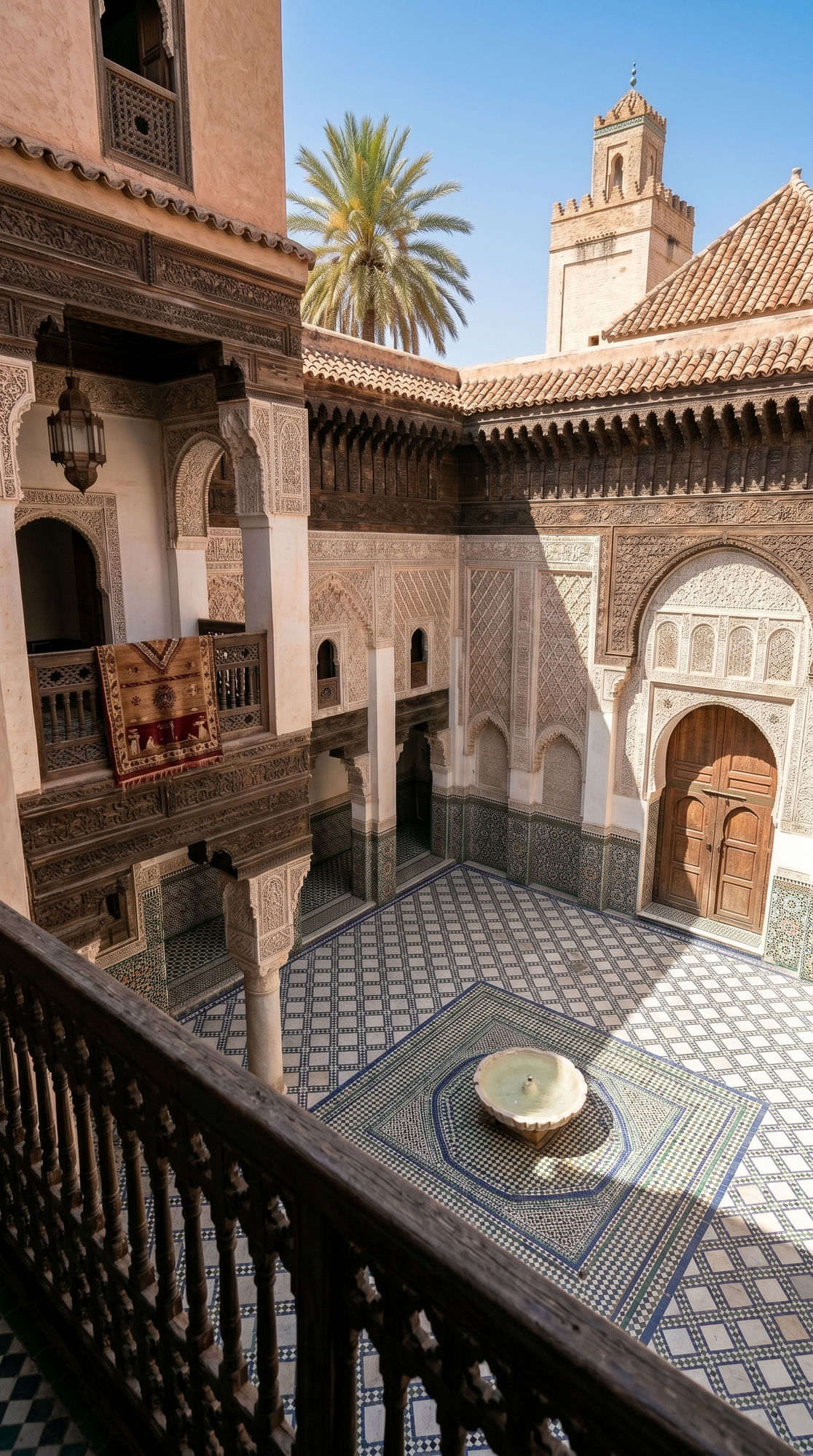
The most photographed space in the palace. For the best composition: stand at the south end of the courtyard and shoot toward the north arcade. Include the orange trees in the foreground for depth. Get low: waist height gives you a floor reflection in the fountain if the water is still. Arrive at 9:00 AM before the crowds break the water surface.
The balcony on the upper level (accessible through the reception hall corridors) offers a second angle looking down onto the courtyard, useful when the floor level is crowded.
2. The Cedar Ceilings
The Council Room and several reception halls have hand-painted cedar ceilings that are among the finest examples of traditional Moroccan craftsmanship ever documented, created by artisans from Fez during the palace's construction between 1894 and 1900 (Encyclopaedia Britannica, Marrakech). To photograph them well: stand directly below the centre of the ceiling panel, shoot straight up, and use the widest lens or setting you have. Night Mode on a modern phone handles the dim light better than flash-off on a camera with a slow lens. A fast prime (f/1.8) eliminates the need for Night Mode entirely.
3. The Zellige Floor Patterns
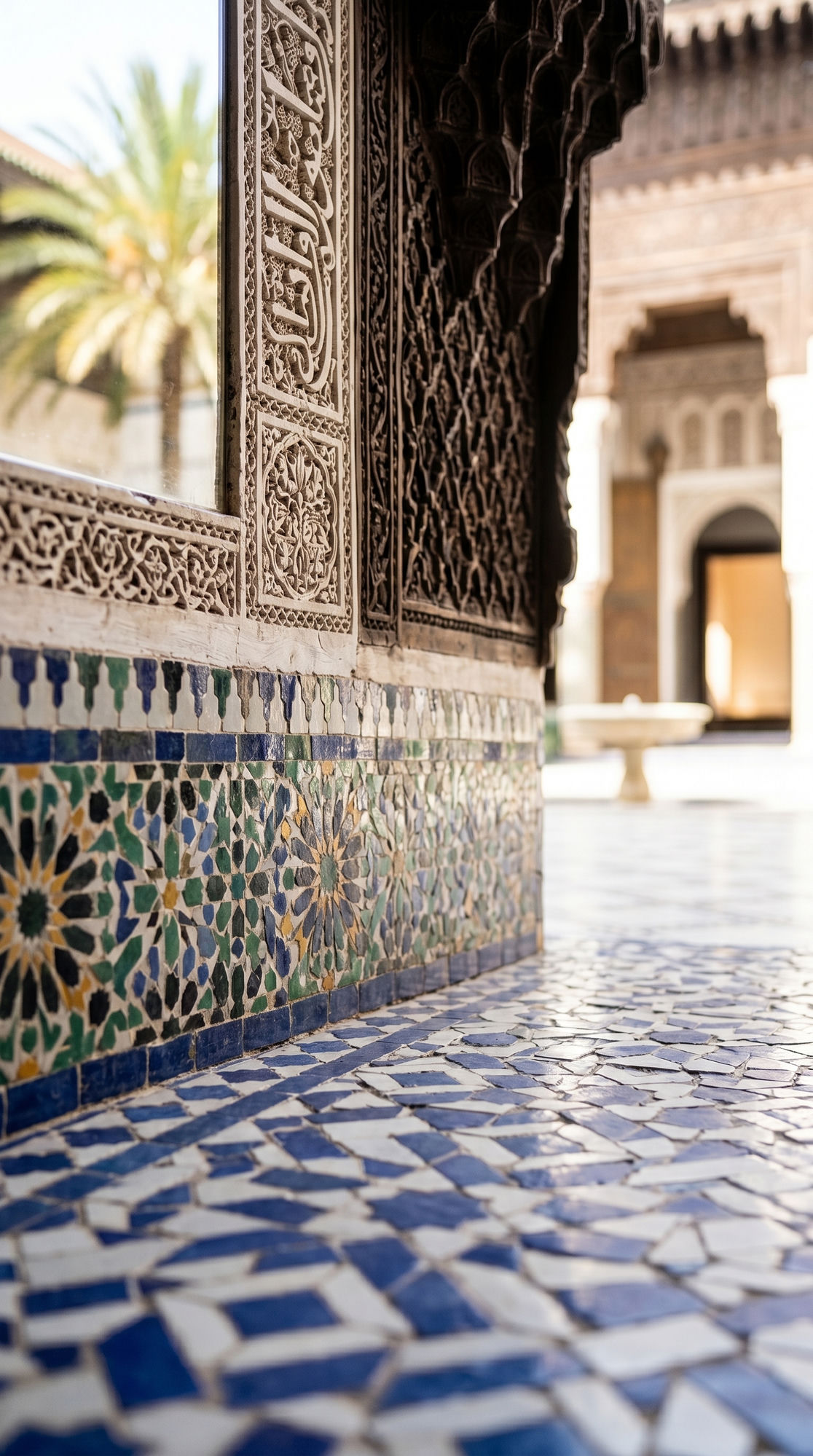
For floor shots: get as low as possible. Kneeling and shooting at a very shallow angle compresses the pattern into a strong graphic image. The polychrome zellige in the Grand Riad is the most complex; the monochrome sections near the entrance are cleaner for geometric abstracts. Morning light creates the shadow depth that makes the slight three-dimensional surface of each cut piece visible.
4. The Doorways and Arches
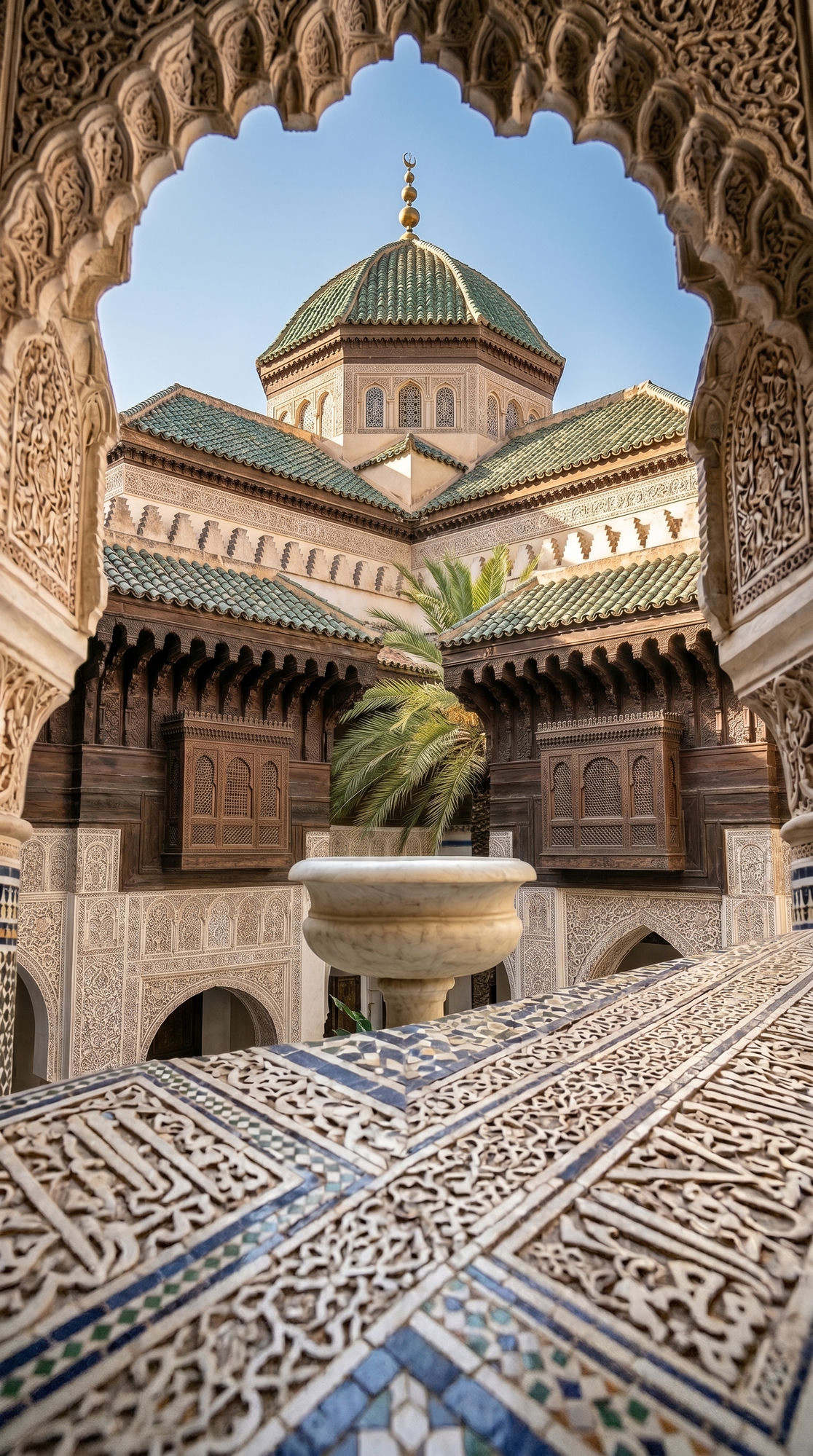
Bahia Palace's carved plaster archways are natural frames. Position your subject (a person, or just the room beyond) inside the arch and expose for the highlights: let the arch fall dark to create a silhouette frame. The transition from the bright courtyard to the dark interior, shot through an arch, is one of the palace's best compositional opportunities. The arch leading from the reception hall toward the Grand Riad is the strongest version of this shot.
5. The Harem Corridor
The long covered corridor leading to the harem quarters creates a strong vanishing-point perspective. Shoot from one end toward the other: include the repetition of archways and the light falling through the mashrabiya windows on one side. This works best before tour groups fill the corridor. After 10:30 AM, a lone person becomes impossible to photograph here without crowds.
6. The Gardens
The palace gardens are excellent in late morning when the light clears the surrounding walls. Shoot the doorways from the garden back into the rooms for a contrast between bright outdoor green and cool shadowed interior. The bougainvillea and jasmine, when in bloom (March through May), add colour that's unusual in an otherwise terracotta-and-white palette. The seasonal guide covers what the garden looks like month by month.
Which Works Better: Camera or Phone at Bahia Palace?
| Situation | Camera | Phone |
|---|---|---|
| Grand Riad (bright, outdoors) | Excellent | Excellent |
| Cedar ceilings (dark interior) | Good with f/1.8+ lens | Good with Night Mode |
| Zellige floor detail | Better (RAW, more control) | Good |
| Archway silhouettes | Better (exposure control) | Good with manual exposure |
| Garden shots | Excellent | Excellent |
| Portability and discretion | Less convenient | Better |
A modern flagship phone (iPhone 15 or later, Samsung Galaxy S24 or later, Pixel 8 or later) produces excellent results in all conditions inside the palace. The main advantage of a dedicated camera is RAW files for post-processing and better low-light performance without the computational noise of phone Night Modes. Both tools work well. Use what you're most comfortable operating quickly when a composition appears in front of you.
What Should You Wear for a Photography Visit?
Clothing matters for photography at Bahia Palace. The interiors are already visually complex: intricate zellige, carved stucco, painted ceilings, and ornate archways. Simple, neutral clothing (cream, white, tan, soft terracotta) sits naturally within this palette. Loud patterns or bright colours compete with the architecture rather than complementing it.
The practical constraint is the dress code: shoulders and knees must be covered. Lightweight linen in neutral tones is both compliant and photogenic. Avoid all-black or all-dark clothing in the courtyard: in the morning light, dark clothing creates strong contrast against the pale zellige that works against most compositions. Full guidance in the dress code and styling guide.
How Do You Get Crowd-Free Shots at Bahia Palace?
- 9:00 AM arrival is your primary tool. The first 60 to 90 minutes are dramatically quieter than anything after 10:30.
- In the Grand Riad, position yourself against one of the columns and wait for gaps between visitor groups. They come in waves, and there are genuine 20 to 30 second windows of empty courtyard.
- Shoot the harem quarters and gardens last: these are where tour groups thin out first, usually by 10:30.
- For ceiling shots, shoot straight up: people walking through the frame are out of the shot entirely.
- Long exposure (if using a tripod early) can blur moving visitors into ghostly transparency. Requires very early morning light levels to work without overexposing the bright courtyard.
For more on crowd timing, the best time to visit guide covers the exact windows by time of day and season. The hidden details guide adds context for what you're actually photographing, which changes how you approach each spot.
Frequently Asked Questions
Can you use a camera with a lens at Bahia Palace?
Yes. Cameras with interchangeable lenses are permitted for personal use. There's no official restriction on lens size for personal photography. Tripods are not prohibited but may attract attention from guards in crowded rooms. The only firm rules are no flash and no drones.
What's the best lens for Bahia Palace photography?
A wide-angle lens (16–24mm equivalent) is most useful for courtyard shots and ceiling photography. A 35–50mm equivalent works well for room details and archway framing. A fast prime (f/1.8 or faster) helps significantly in the darker interior rooms. For phone photography, use the standard or ultra-wide lens: the telephoto performs poorly in low light.
Is there a photography fee at Bahia Palace?
No. Personal photography (photos and video for private use) is completely free at Bahia Palace. There is no camera entry fee or photography permit required for tourists. The only prohibitions are flash photography, drones, and commercial photography, which requires prior Ministry of Culture approval.
Can I take photos in the harem quarters?
Yes. All sections of the palace open to visitors, including the harem quarters and private apartments, are open to personal photography without restriction. The no-flash rule applies throughout. These rooms are some of the most photographically interesting in the palace, with smaller-scale tilework and more intimate lighting than the grand reception halls.