
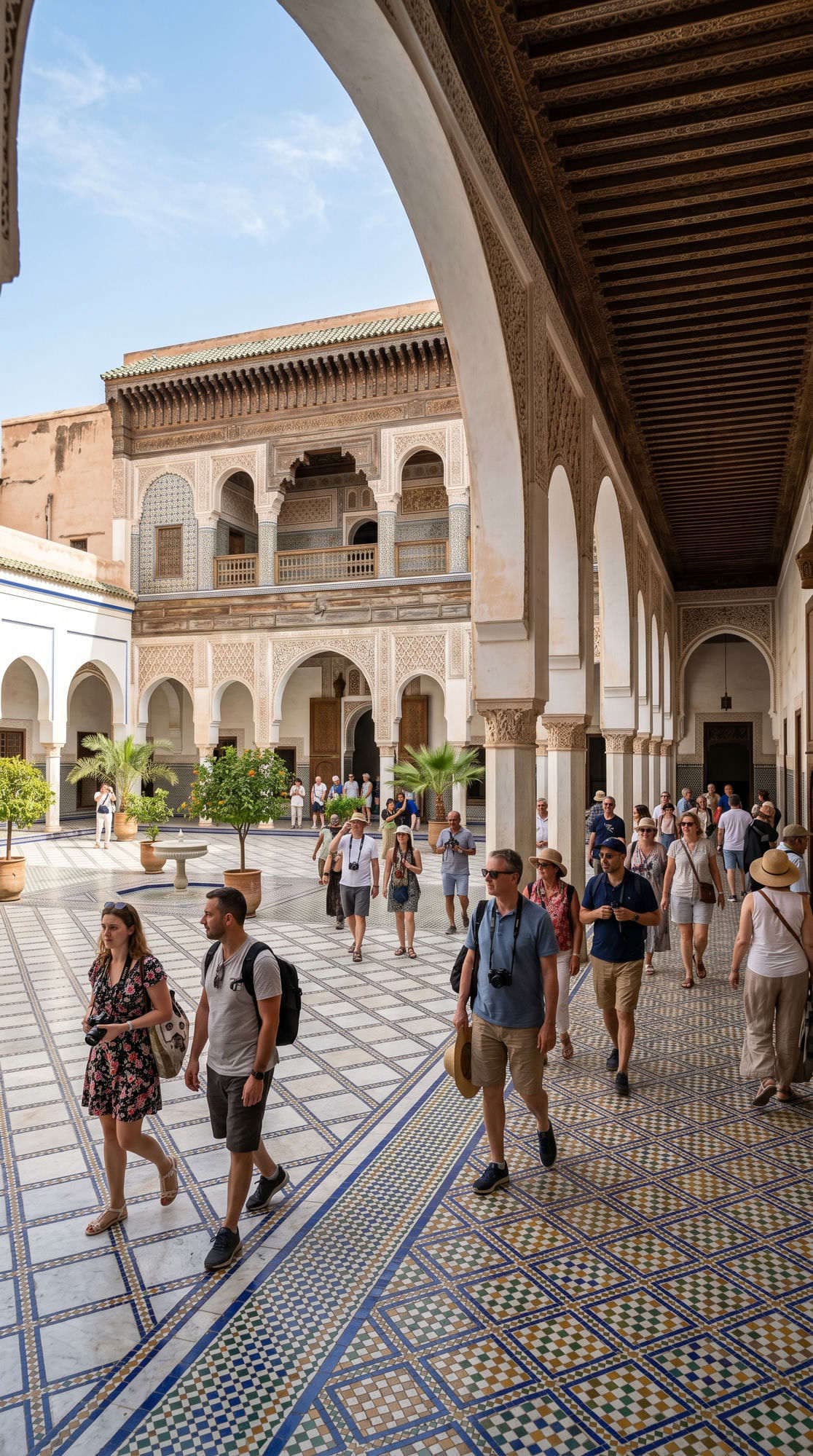
Each year, visitors arrive at the gates of Bahia Palace dressed for a beach day — shorts, tank tops, spaghetti straps — and are turned away or handed a robe before they can enter. It's an awkward moment that's entirely avoidable with five minutes of preparation. Morocco is a Muslim-majority country, and Bahia Palace is a historic royal monument managed by Morocco's Ministry of Culture (e-services.minculture.gov.ma). Modest dress is expected, and while enforcement varies, it's never worth the risk of being refused at the door after walking 20 minutes through the medina to get there.
Key Takeaways
- Shoulders and knees must be covered for entry. This applies to all genders. Enforcement is inconsistent, but the risk of being turned away is real on busy days.
- The best practical approach: lightweight linen or cotton trousers and a short-sleeve top. This keeps you cool in the heat and compliant at every historic site in Marrakech.
- A light scarf or wrap in your bag is the simplest insurance policy. It adds zero weight and can cover bare shoulders in 10 seconds if needed at any point in your day.
Is There a Strict Dress Code at Bahia Palace?
Bahia Palace does not publish a formal written dress code the way some mosques do. However, the cultural expectation is clear: shoulders and knees should be covered for all visitors. In practice, enforcement is inconsistent. On quieter days, visitors in shorts occasionally get through. On busy days, if a guard is checking, you may be stopped, asked to cover up, or directed to rent a wrap at the entrance.
The safest approach is to dress appropriately from the start. You'll be more comfortable inside anyway. Loose, light fabrics are far more practical than tight, revealing clothing in the Marrakech heat. Morocco's National Tourism Office welcomed 17.4 million international visitors in 2024 (ONMT, Morocco Tourism Annual Report 2024). Bahia Palace is one of the country's most-visited cultural sites, and it reflects the same standards expected across Morocco's historic monuments.
What Should Women Wear to Bahia Palace?
- Lightweight trousers, linen pants, or a maxi skirt (knee-length or longer)
- A top with sleeves: at minimum, cap sleeves. Short sleeves are fine; sleeveless tops are not.
- A loose-fitting dress that covers the shoulders and falls past the knee
- A light cardigan, kimono, or wrap that can cover bare shoulders if needed
A common and practical choice: wide-leg linen trousers plus a short-sleeve top plus a light scarf in your bag. The scarf doubles as a cover-up if needed and costs nothing to carry. Choose linen and cotton: they breathe well and keep you cool even when covering up. In our experience, visitors who plan around this approach have zero issues at any historic site in Marrakech, not just Bahia Palace.
What Should Men Wear to Bahia Palace?
Men face fewer restrictions in practice, but the same general rule applies: no bare shoulders, and shorts should fall at or below the knee.
- Chinos, lightweight trousers, or longer shorts (knee-length or below)
- A t-shirt, polo, or short-sleeve shirt
- Light sneakers or sandals with good grip
If you're already in Marrakech and dressed more casually, a lightweight shirt thrown over a tank top is enough. The key is covering the shoulders: bare-shoulder vest tops are the most common reason men are stopped at the entrance.
What Clothing Should You Avoid at Bahia Palace?
These items may result in being turned away or an uncomfortable conversation at the entrance gate:
- Sleeveless tops and vest tops for any gender
- Short shorts or mini-skirts — anything falling significantly above the knee
- Low-cut or sheer tops — even if they technically have sleeves
- Swimwear of any kind
- Crop tops — they expose the midriff
- Flip-flops with no grip — the palace floors are smooth polished stone and tile; slippery footwear is a practical hazard regardless of dress code
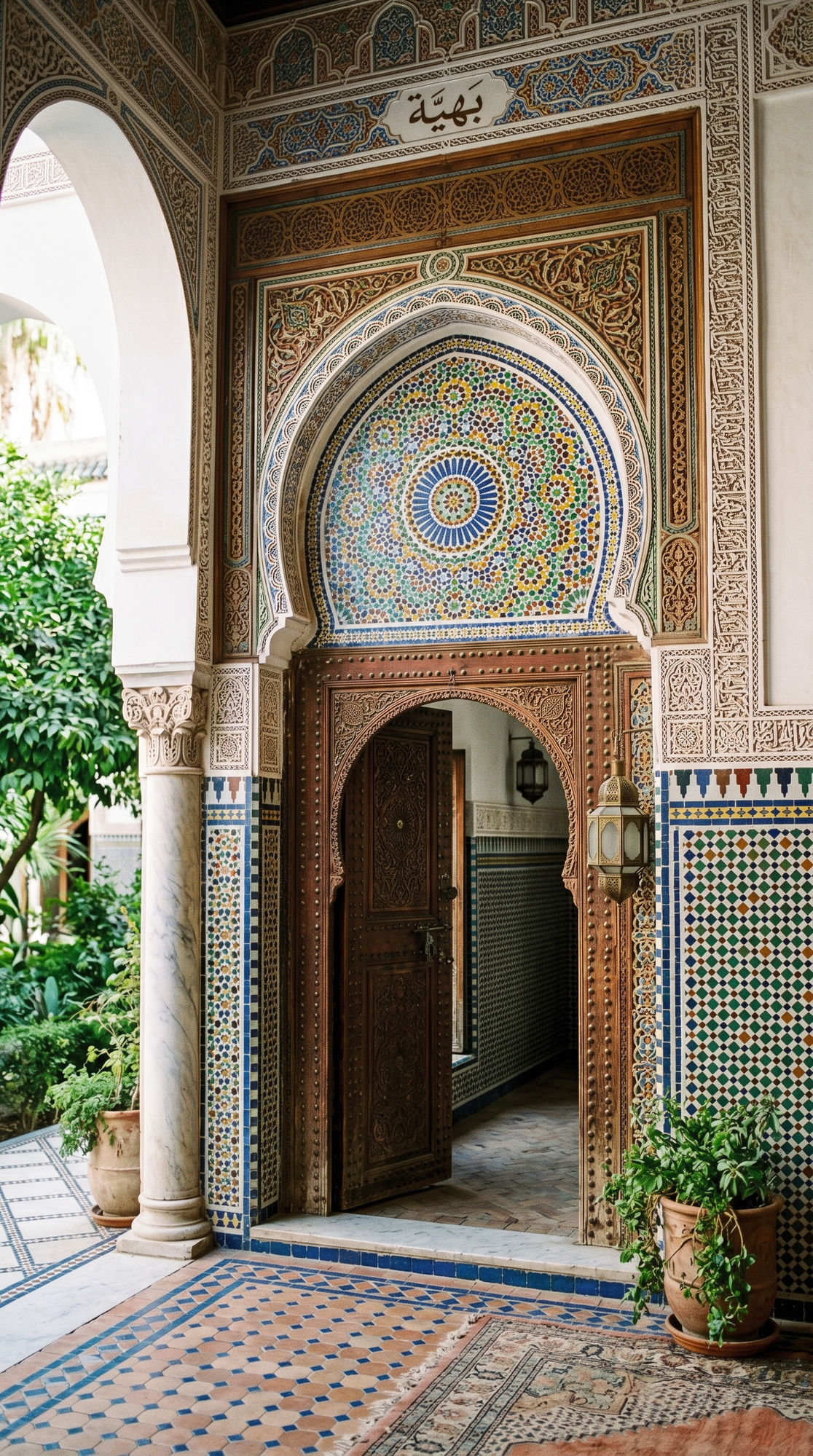
The zellige tilework and carved stucco at Bahia Palace have been in place for more than 125 years. The palace is treated as a major national heritage site under UNESCO-listed Medina of Marrakesh protections (UNESCO World Heritage List, entry #331). Appropriate dress is both a courtesy to the monument and a practical necessity for entry.
What If You Forget?
If you arrive underdressed, you have two options:
Option 1: Scarves and wraps at the entrance. Vendors outside Bahia Palace, and sometimes staff at the entrance, offer lightweight wraps or sarongs to borrow or purchase. The price is typically 10 to 30 MAD for a purchase, or a small tip for a borrowed item.
Option 2: A nearby shop. The streets immediately surrounding Bahia Palace are lined with small shops selling scarves, light cotton trousers, and djellabas. A basic cotton wrap costs very little and you'll use it at other sites in Marrakech too. Do not rely on either of these as your plan. Come dressed appropriately.
Dressing for Bahia Palace and a Full Medina Day
If Bahia Palace is part of a larger Marrakech day, the same clothing that gets you through the palace will serve you well across the entire Medina. The souks, the Saadian Tombs, El Badi Palace, and the Ben Youssef Madrasa all expect the same standards as Bahia Palace. Dressing once and forgetting about it for the whole day is simpler than navigating different rules at each site.
The practical formula: lightweight linen or cotton in neutral tones (cream, tan, olive, white) is both practical and photogenic throughout the Medina. Darker colours absorb more heat in the Marrakech sun. Avoid elaborate patterns or loud colors if you're planning to photograph the palace interiors; the tilework and architecture are already visually complex, and simpler clothing usually produces better photographs.
For photography-specific outfit advice, see the color guide for photographing Bahia Palace.
What Other Rules Apply Inside the Palace?
Photography: Allowed throughout the palace. No flash photography — this is actively enforced to protect the painted woodwork and pigments. Drone use is not permitted inside or in the immediate vicinity. Full photography rules are covered in the photography guide.
Shoes: You do not need to remove your shoes. Bahia Palace is not a mosque. Comfortable, closed-toe shoes or sandals with good grip are strongly recommended: the zellige floors are beautiful and slippery.
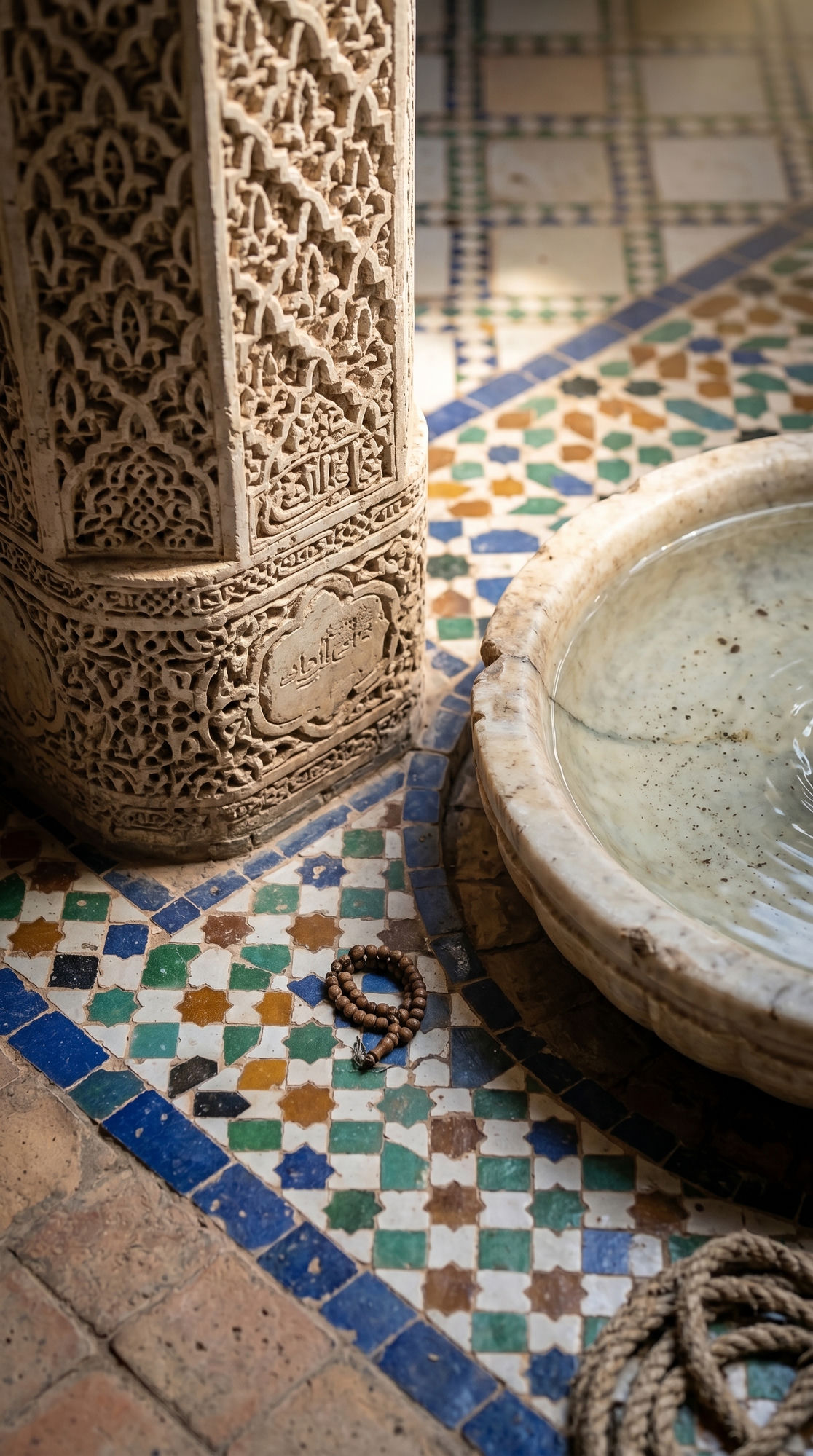
Touching the tilework and woodwork: Don't. The zellige mosaics and carved stucco are centuries old and fragile. Staff will intervene.
Food and drink: Eating inside the palace is not permitted. You can bring a water bottle. Staying hydrated in Marrakech is genuinely important, especially in summer.
Noise and behaviour: Bahia Palace is a heritage monument. Loud music, shouting, or disruptive behaviour is inappropriate and may attract intervention from palace security.
Frequently Asked Questions
Do I need to cover my head at Bahia Palace?
No. Bahia Palace is a historic royal palace and cultural monument, not an active mosque. Head coverings are not required for any visitors regardless of gender. Covering your shoulders and legs is the key expectation.
Can I wear shorts to Bahia Palace?
Men can wear knee-length or longer shorts without issue in most cases. Women in shorts that fall above the knee may be asked to cover up. The safest approach for anyone is trousers or a skirt that reaches the knee or below. If in doubt, carry a scarf or wrap that can be tied around the waist as a precaution.
What should I wear to Bahia Palace in summer?
In summer (June–August), temperatures in Marrakech regularly exceed 38°C. Loose, light-coloured linen or cotton that covers your shoulders and knees will keep you significantly cooler than tight, dark, or synthetic fabrics. A hat and sunscreen are important for the walk through the medina. See the seasonal visit guide for heat management during a summer visit.