
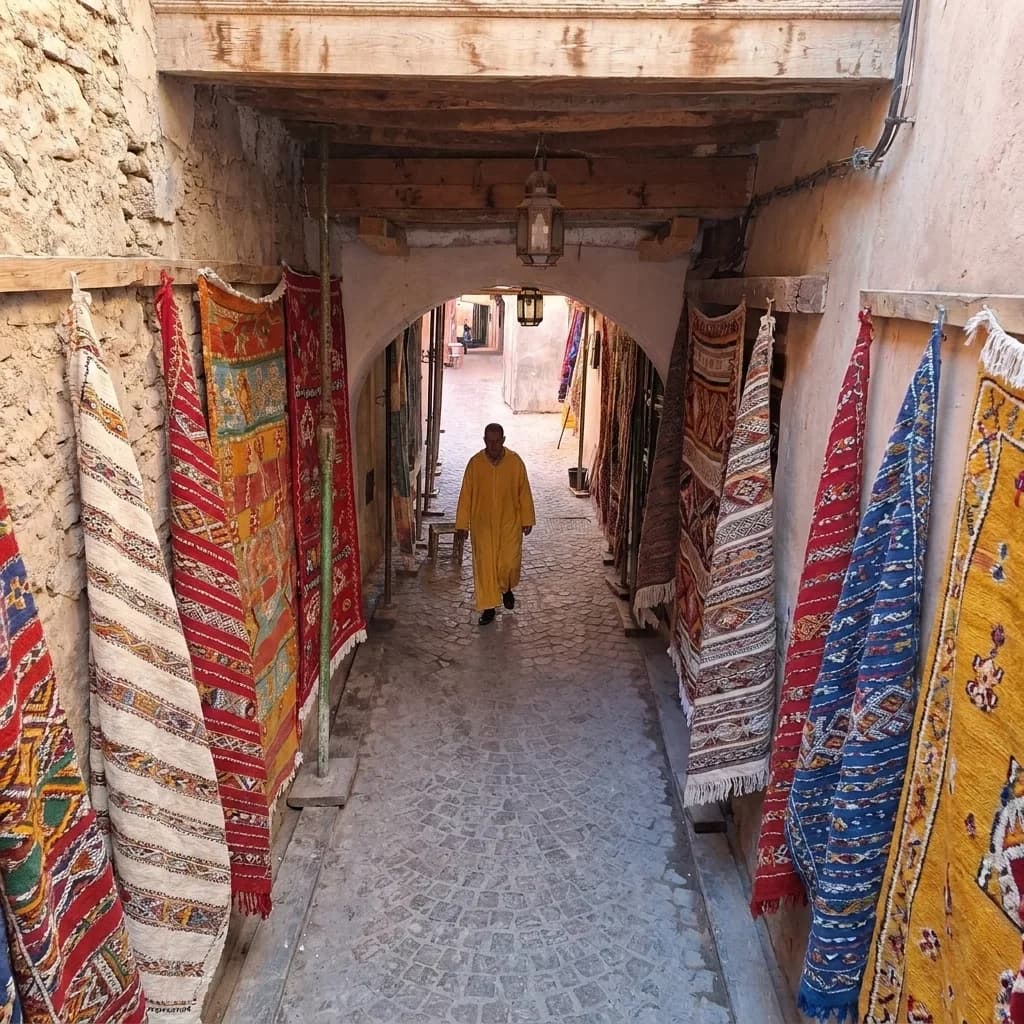
Walk out of the main gate of Bahia Palace, turn left, and within two minutes the medina changes. The lanes narrow. The buildings get taller, four and five storeys where the rest of the medina rarely exceeds two. Balconies appear, which almost nothing else in the old city has. You are in the Mellah, and the architecture is the first clue that this quarter developed under different rules.
Most people who visit Bahia Palace never walk those two minutes. That is the single biggest missed opportunity in this part of the medina.
What is the Mellah?
The Mellah is the historic Jewish quarter of Marrakech, established in the 16th century in the southern medina, immediately adjacent to the royal palace district and to what would later become Bahia Palace.
The name is generally traced to melh, salt, though the explanations offered for the connection vary and none is settled. Similar quarters were established in Fez and other Moroccan cities.
The arrangement was a real mix of protection and constraint. Jewish communities in Moroccan cities were placed under the direct protection of the sultan, and locating the quarter beside the palace was part of that. It also meant confinement to a defined area with gates that were closed at night, and a set of restrictions that applied to residents and not to their neighbours.
The population declined sharply in the 20th century, with most of Marrakech's Jewish community emigrating after 1948 and through the following decades. Only a very small community remains today. What survives in the quarter is the built fabric, a working market, a functioning synagogue and a large cemetery.
Why the buildings look different
This is the thing worth noticing on the ground, and it explains itself once you know the constraint.
The Mellah was a fixed area with a growing population and nowhere to expand outward. So it expanded upward. Buildings here run to four or five storeys where the surrounding medina is mostly two, and they carry external balconies overlooking the street, which the traditional Moroccan medina house does not do at all. The standard medina house turns inward around a courtyard and shows the street a blank wall.
You can read a social history off the rooflines. Density under constraint, and a building tradition that solved it differently.
What to see in the Mellah today
The Lazama Synagogue
The Lazama Synagogue, also written Slat al-Azama, is the best-known surviving synagogue in the quarter and is generally open to visitors for a small entrance donation.
It is built in the standard Moroccan pattern: rooms arranged around a bright blue interior courtyard, with the prayer hall opening off it. The blue is the first thing you notice and it is striking against the white. There is usually a small display on the history of the community.
Practical notes: it is not signposted in any obvious way from the main lanes, entry is through an unremarkable door, and it closes on Saturdays for Shabbat and on Jewish holidays. Dress as you would for any place of worship. Ask before photographing, and expect the answer to be no in the prayer hall.
The Mellah market
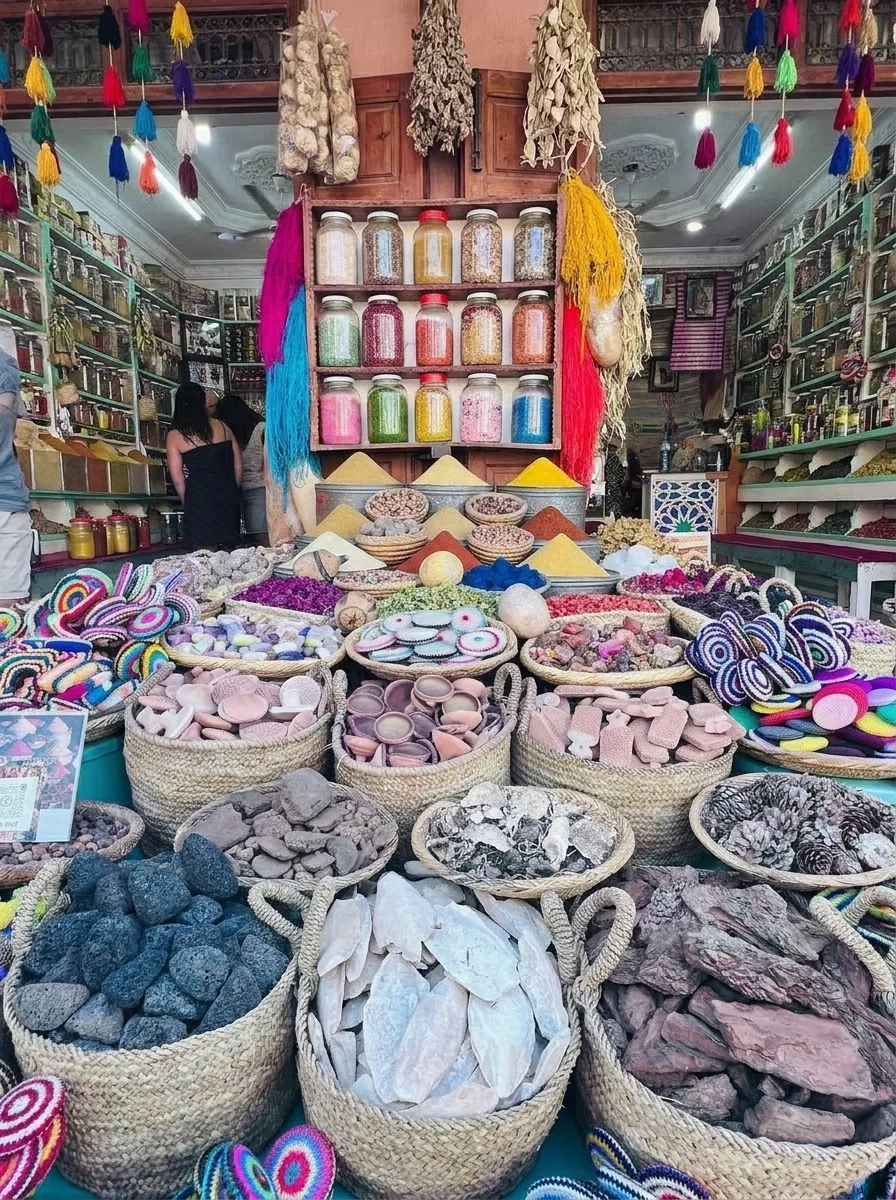
The spice and produce market in the Mellah is one of the better markets in the medina for a specific reason: it is largely aimed at people who live here.
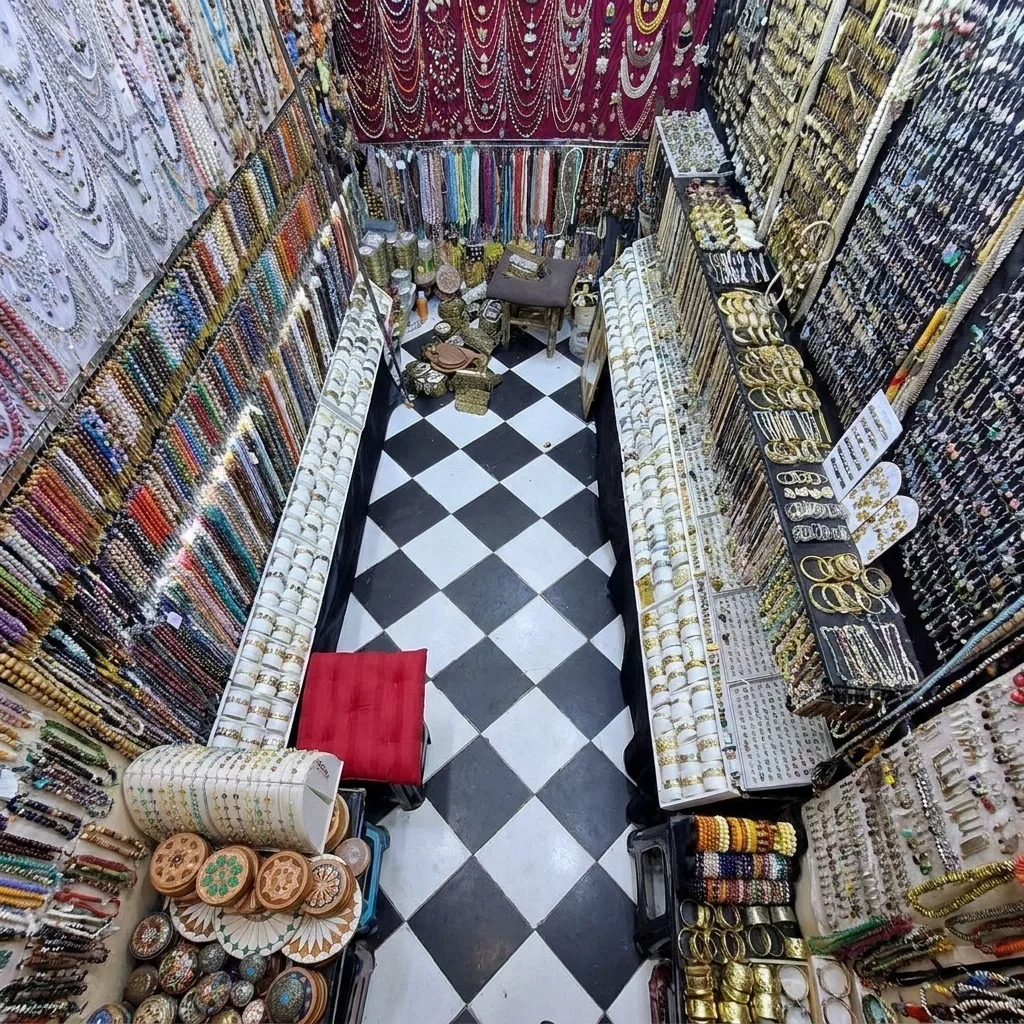
Prices are lower than the tourist souks north of Jemaa el-Fna and the pressure to buy is far gentler. You will see spices sold in open sacks, preserved lemons, olives in a dozen preparations, fresh produce, and a concentration of jewellery workshops. The jewellery trade here has deep roots in the quarter's history.
It is compact and easy to walk. If the intensity of the main souks has worn you down, this is the calmer version. Our Marrakech safety and scams guide still applies, but you will find much less of it here.
The Miâara Jewish cemetery
The Miâara is the old Jewish cemetery, a large walled site of white-plastered graves laid out in rows.
It is a quiet, exposed, slightly overwhelming place, with a scale that tells you how substantial this community once was. There is usually a caretaker at the gate; a donation is customary. Men are generally asked to cover their heads and a covering is provided if you do not have one.
This is a burial ground, not an attraction. Keep your voice down, do not walk on the graves, and be thoughtful about photographs.
Just walking
Honestly, the best thing to do in the Mellah is walk it without a target. It takes maybe forty minutes to cover the main lanes. Look up at the balconies, notice the shift in scale from the medina you have just come from, watch a quarter that is residential rather than commercial go about its day.
How to combine the Mellah with Bahia Palace
The Mellah is directly adjacent to Bahia, which makes this one of the easiest pairings in the medina.
A workable half-day:
- 9:00 Bahia Palace at opening, 75 to 90 minutes. Quietest hour of the day.
- 10:30 Walk into the Mellah. Market first while it is active.
- 11:15 Lazama Synagogue.
- 12:00 Miâara cemetery, if you want it, or straight to lunch.
- 13:00 Lunch in the Kasbah.
If you would rather add a second monument than a neighbourhood, El Badi Palace is about ten minutes' walk and the Saadian Tombs pair naturally with Bahia in one morning. The Mellah is the better choice if you have already seen two monuments and want something with a pulse rather than another empty palace. Our things to do near Bahia Palace piece sets out the full set of options within walking distance.
For visitors on a tight schedule, the Mellah slots neatly into our one-day Marrakech itinerary as an alternative to the northern souks.
Visiting respectfully
This quarter is somebody's neighbourhood and, in the case of the synagogue and cemetery, somebody's living religious heritage. A short list:
Cover up. The same standard that applies at Bahia Palace applies here, and slightly more so at the synagogue and cemetery. Shoulders and knees.
Ask before photographing people. Especially in the market, and especially children. The answer will often be yes and the interaction will be better for having asked.
No photography inside the synagogue prayer hall unless you are explicitly told otherwise.
Give the donation. Both the synagogue and the cemetery are maintained on very little. The expected amount is small and it is the mechanism by which these sites stay open.
Saturdays. The synagogue closes for Shabbat. If your only free day is Saturday, plan the market and the walk instead.
Do not go hunting for "authentic" poverty. The residential lanes are homes. Walking them is fine; treating them as a photo subject is not.
Where to eat nearby
The Mellah itself has limited sit-down options aimed at visitors, which is part of its character. Two approaches:
Eat in the market. Fresh bread, olives, dates, preserved lemons, a bag of spices to take home. This is the cheapest and best-value food in the area and it costs a fraction of a restaurant meal.
Walk to the Kasbah. The area around Bahia Palace and toward the Kasbah has the concentration of restaurants, from rooftop terraces to small local places. Our guide to restaurants near Bahia Palace covers what is close and what is worth the walk.
One honest note on the rooftop restaurants in this area: several of them charge a significant premium for the view, and the food is ordinary. You are paying for the terrace. Sometimes that is a fair trade at sunset. At 1pm in August it is not.
Is the Mellah safe?
Yes, with the ordinary caution you would apply anywhere in the medina.
It is residential and quieter than the main souks, which most visitors find more comfortable rather than less. The usual medina issues apply: unofficial guides offering to show you the way, occasional insistence that a street is closed when it is not, and mopeds in narrow lanes. Our safety guide covers the specific routines you will meet and how to end them politely.
Two practical points. The lanes are genuinely confusing and mapping apps struggle here, so allow for getting turned around. And the quarter empties in the evening, so if you want to walk it, do it in daylight.
How long do you need?
Ninety minutes covers the market, the synagogue and a proper walk. Add another 30 to 40 minutes if you want the cemetery, which is a little further and deserves an unhurried visit.
Combined with Bahia Palace, budget half a day for the pair. That is a comfortable morning rather than a rushed one, and it is one of the better half-days in the southern medina.
Frequently asked questions
What is the Mellah in Marrakech?
The historic Jewish quarter of the city, established in the 16th century in the southern medina next to the royal palace district. It sits immediately adjacent to Bahia Palace and is recognisable by its taller buildings and street-facing balconies, which the rest of the medina does not have.
How far is the Mellah from Bahia Palace?
About two minutes on foot. They are directly adjacent, which makes them one of the easiest pairings in the medina and an obvious half-day combination.
Can you visit the Lazama Synagogue?
Yes, it is generally open to visitors for a small donation. It closes on Saturdays for Shabbat and on Jewish holidays. Dress modestly, ask before taking photographs, and expect photography inside the prayer hall to be restricted.
Is the Mellah market cheaper than the main souks?
Generally yes. It serves local residents rather than tourists, so prices are lower and the pressure to buy is much gentler than in the souks north of Jemaa el-Fna. It is a good place to buy spices, olives and preserved lemons.
Is the Mellah worth visiting?
If you have already seen two or three monuments and want something that is lived-in rather than preserved, it is the best short walk in the southern medina. If you have only one morning in Marrakech, a monument will probably give you more.
Are there still Jewish residents in the Mellah?
Only a very small community remains. Most of Marrakech's Jewish population emigrated after 1948 and across the following decades. The synagogue still functions, and the cemetery and built fabric of the quarter survive.
Most people who see the Mellah come to Bahia Palace first. Entry to the palace is the official 100 MAD with no booking fee on top, and our ticket page explains how it works before you set off.