
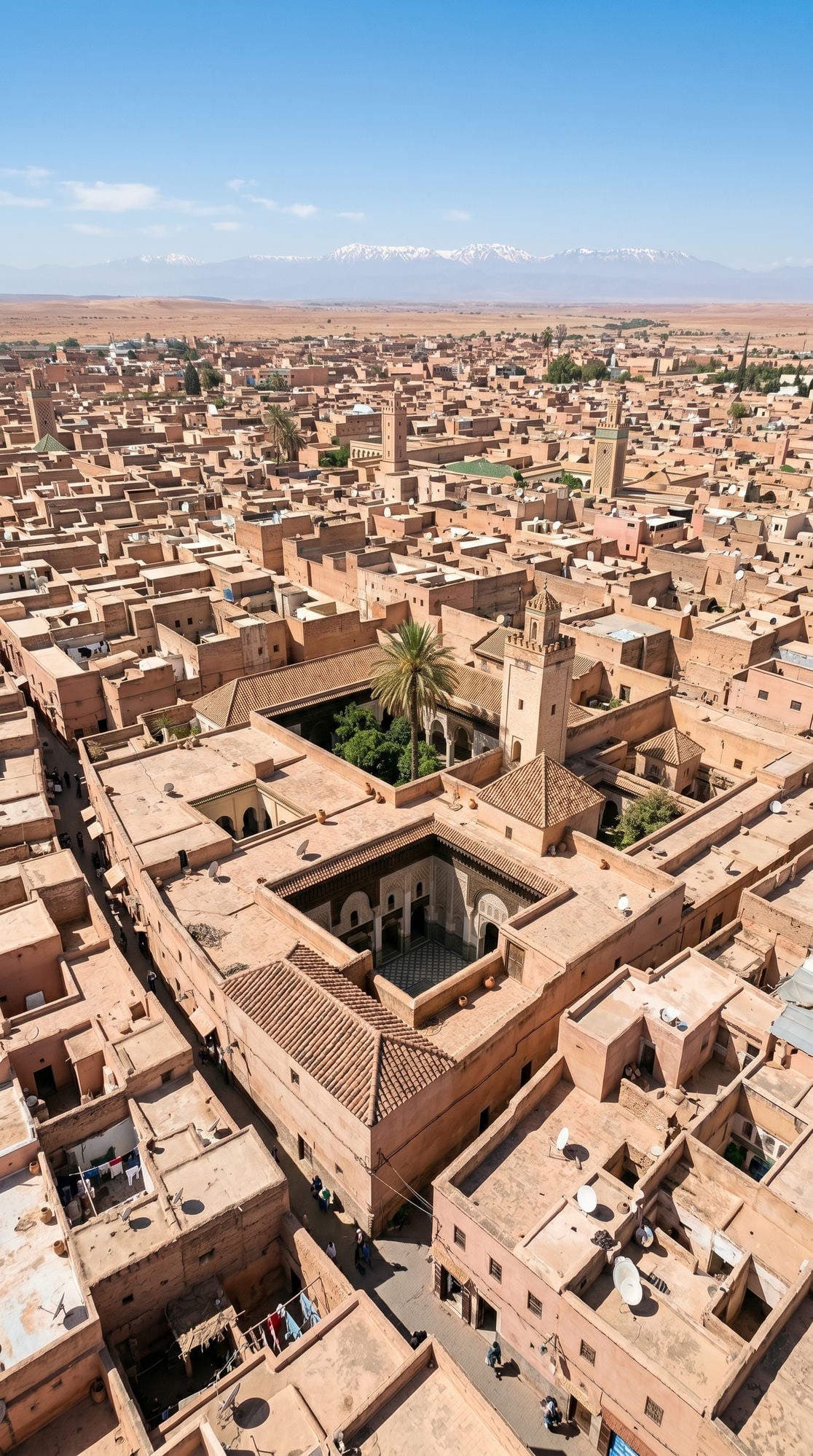
The short answer: the area immediately around Bahia Palace is the most monument-dense part of Marrakech. Within a 10-minute walk you have two more major paid sites (the Saadian Tombs and El Badi Palace), a historic Jewish quarter, a craft museum, and one of the best free squares in the city. You can put together a serious half-day here without a taxi, or a full-day if you add Jemaa el-Fna at the end.
This is the overview hub. Where a dedicated article already covers one of these attractions in depth, there's a link — no point repeating a 1,500-word guide when it already exists. The goal here is to help you decide what to combine and in what order.
- The Saadian Tombs (7 min walk), El Badi Palace (10 min), and Dar Si Said Museum (5 min) can all be combined with Bahia Palace in a single morning — total ticket cost 300 MAD for the three Ministry of Culture monuments (Bahia Palace, Saadian Tombs, El Badi Palace); Dar Si Said — verify entry on arrival.
- The Mellah and Place des Ferblantiers are free, immediate, and usually missed by visitors who rush between paid sites.
- Jemaa el-Fna is 15–20 minutes on foot — walkable, but better saved for the afternoon or evening when the square comes alive.
- The ideal order: Bahia Palace first (9:00 AM, quietest then), Saadian Tombs second, El Badi third. Everything else fills in around those anchors.
What's Within Walking Distance of Bahia Palace?
All distances below are approximate walking routes through the medina, not straight-line.
| Attraction | Walk from Bahia Palace | Entry (June 2026) | Time needed |
|---|---|---|---|
| Place des Ferblantiers | 4 min (~300 m) | Free | 15–20 min |
| Mellah (Jewish Quarter) | 2–5 min (adjacent) | Free | 20–45 min |
| Dar Si Said Museum | 5 min (~400 m) | Verify on arrival | 30–45 min |
| Saadian Tombs | 7–10 min (~650 m) | 100 MAD | 30–45 min |
| El Badi Palace | 10 min (~800 m) | 100 MAD | 45–60 min |
| Kasbah Mosque (exterior) | 8 min (~600 m) | Free (exterior only) | 5–10 min |
| Jemaa el-Fna | 15–20 min (~1.5 km) | Free | 1–3 hours |
Prices shown are 2026 rates for foreign adults — verify before visiting. Both Bahia Palace and the Saadian Tombs are cash-only at the door. Visitors with reduced mobility enter free. Moroccan nationals enter free every Friday and on the first day of national and religious holidays.
Saadian Tombs — 7 Minutes on Foot
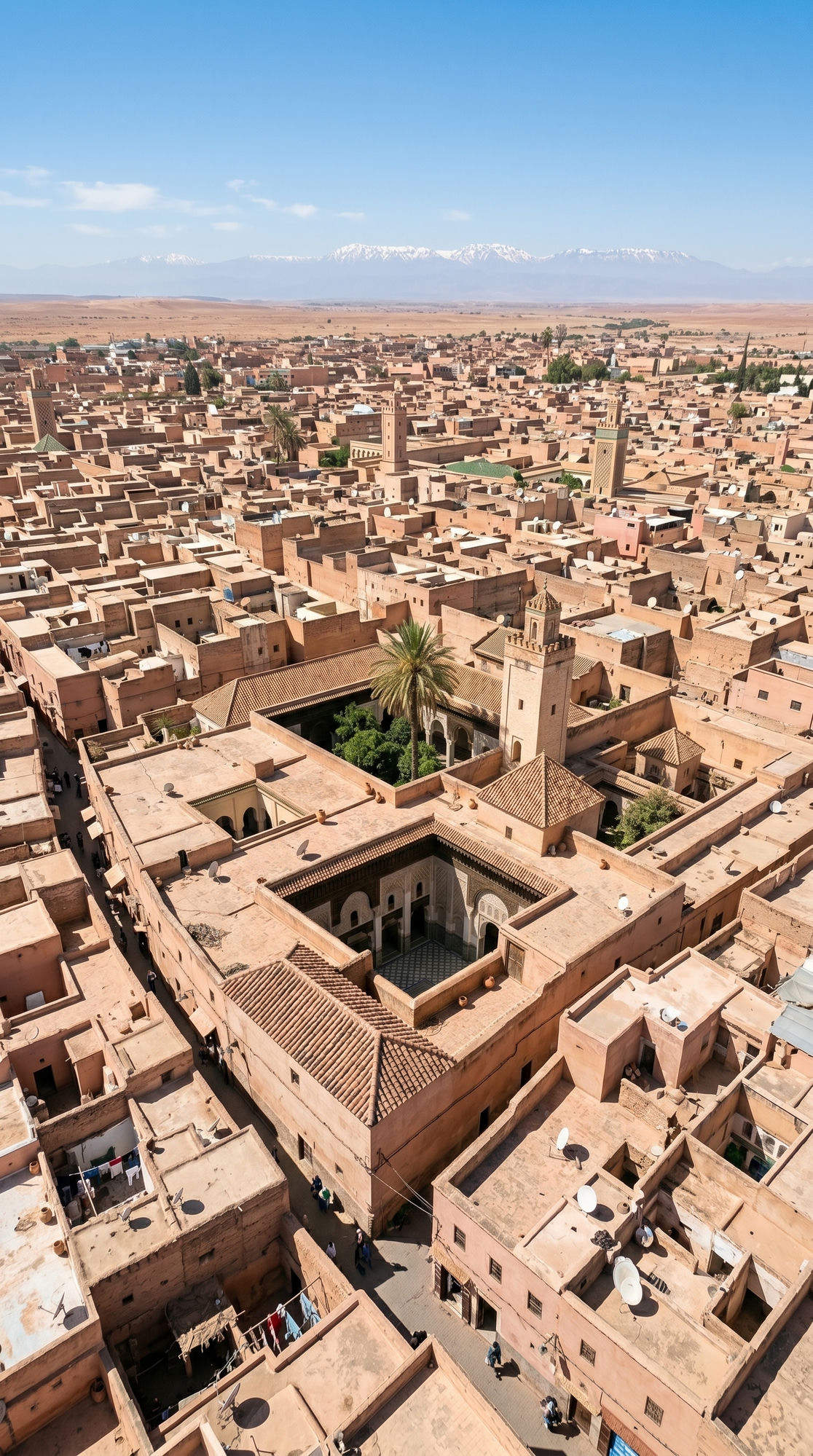
The most important stop after Bahia Palace. The Saadian Tombs are a 16th-century royal mausoleum containing the burial chambers of 66 members of the Saadian dynasty, built under Sultan Ahmad al-Mansur. Three rooms of carved plaster and zellige tilework surround the tombs — one of the finest concentrations of Moroccan decorative craft in a single space. The site was sealed by Sultan Moulay Ismail in the 17th century and not rediscovered until 1917, which is why it survived intact. Entry: 100 MAD (foreign adult). Time needed: 30–45 minutes.
The experience is very different from Bahia Palace: small, focused, and intensely detailed in a compact space rather than vast and varied. If you only visit one after Bahia Palace, this is it.
Full logistics, best timing, and what order to visit in: Bahia Palace and Saadian Tombs in one day.
El Badi Palace — 10 Minutes on Foot
Built by the same sultan who commissioned the Saadian Tombs, El Badi Palace was once considered one of the greatest palaces in the world. It was systematically dismantled by Sultan Moulay Ismail in the late 17th century — marble columns, gold, and ornamental pieces were stripped out and transported to Meknès to furnish his own palace. What remains is a vast, rootless ruin: enormous open courtyards, sunken gardens, stork nests on every tower, and a sense of scale that contrasts sharply with the intimacy of the Saadian Tombs. Entry: 100 MAD (foreign adult). Time needed: 45–60 minutes.
El Badi is often skipped because it reads as "just ruins." That framing misses it. The emptiness is the point — you're standing inside a palace that once outdid Versailles, looking at what deliberate destruction looks like at architectural scale. Worth an hour of anyone's time.
For a direct comparison with Bahia Palace — what each offers and who should prioritise which — see Bahia Palace vs El Badi Palace.
Place des Ferblantiers — 4 Minutes on Foot
The Square of the Tinsmiths sits between Bahia Palace and El Badi Palace, and most visitors walk straight through it. Don't. The workshops around the square still produce the pierced-metal lanterns visible in every traditional Moroccan interior: craftsmen cut, hammer, and solder them by hand in the small workshops on the square's perimeter. It's free, takes 15 minutes, and gives you a working artisan context that the palace interiors lack. There are also a few low-key cafés on the square — good for a mint tea between sites.
Mellah — The Old Jewish Quarter
The Mellah is Marrakech's historic Jewish quarter, directly east of Bahia Palace. At its height in the 19th century it housed one of Morocco's largest Jewish communities. Today it's a dense residential and commercial neighbourhood with a covered market, silversmith stalls, and some of the best fresh-produce vendors in the medina. The architecture is distinct from the rest of the medina: narrow streets lined with houses that have wooden balconies projecting over the lane — a style specific to the Mellah.
It's free and immediate — you walk through it between Bahia Palace and the Saadian Tombs if you follow the direct route. Give it 20 minutes rather than rushing through. The covered Mellah market in particular is worth a slow walk for anyone interested in Moroccan food culture: spices, preserved lemons, olives, argan oil, and fresh herbs sold by neighbourhood residents rather than tourist-facing vendors.
Dar Si Said Museum — 5 Minutes on Foot
Dar Si Said is a 19th-century palace built by Si Said, the brother of Ba Ahmed who built Bahia Palace — the family resemblance in the architecture is immediately apparent. It now operates as a museum of Moroccan decorative arts: zellige, carved plasterwork, cedar joinery, jewelry, textiles, and woodwork collected from across Morocco. Entry: verify on arrival. Time needed: 30–45 minutes.
It's a genuine museum rather than a monument, which makes it a different kind of visit. The collection is strongest on woodwork and zellige — if you've spent an hour looking at Ba Ahmed's craftwork in Bahia Palace, the context here is illuminating. Less crowded than the main sites and rarely has a queue.
Kasbah Mosque — 8 Minutes on Foot
The Kasbah Mosque (also called the Mosque of Moulay el-Yazid) is one of the oldest mosques in Marrakech, with a minaret decorated in zellige and carved stucco that rivals the Koutoubia for ornamental quality. Non-Muslim visitors cannot enter — but the exterior and minaret are visible from the street and worth the short walk. The Saadian Tombs are immediately adjacent to the mosque's southern wall; you'll see the minaret on your way there.
Jemaa el-Fna — 15–20 Minutes on Foot
Marrakech's central square is UNESCO-listed as Intangible Cultural Heritage (2001) for its living performance tradition: musicians, storytellers, acrobats, henna painters, and food vendors who set up every afternoon and evening. It's free to enter. The square is quiet in the morning — mostly juice stalls and a few performers — and reaches full intensity from around 6:00 PM onwards. If you're combining it with a morning Bahia Palace visit, plan to walk there after lunch and stay into the evening.
The walk from Bahia Palace to Jemaa el-Fna (via Rue Riad Zitoun el Jedid) takes 15–20 minutes and is one of the most interesting walks in the medina. See the route between Jemaa el-Fna and Bahia Palace for the walking directions in both directions.
Suggested Routes
Half-Day Route (3–4 hours)
This covers the three paid sites and leaves you free by early afternoon:
| Time | Activity |
|---|---|
| 08:50 | Arrive at Bahia Palace before opening. Pre-booked ticket holders go straight to the entrance. |
| 09:00 | Bahia Palace. Spend 75–90 minutes on the courtyards, harem wing, and gardens. |
| 10:30 | Exit south through the Mellah. Slow down for the covered market (10 min). |
| 10:40 | Saadian Tombs. Prioritise the Hall of Twelve Columns. 35–40 minutes. |
| 11:25 | Walk west via Place des Ferblantiers (pause 10 min for the lantern workshops). |
| 11:40 | El Badi Palace. 50–60 minutes in the ruins. |
| 12:45 | Lunch. Head north toward Jemaa el-Fna, or eat at one of the cafés near Place des Ferblantiers. |
Total paid entry for the three Ministry of Culture monuments: 300 MAD per foreign adult (Bahia Palace 100 + Saadian Tombs 100 + El Badi Palace 100). Dar Si Said Museum — verify entry on arrival. Three of Morocco's most significant monuments before noon.
Full-Day Route (6–7 hours)
Add Dar Si Said and Jemaa el-Fna to the half-day above:
| Time | Activity |
|---|---|
| Morning | Half-day route above (Bahia Palace → Mellah → Saadian Tombs → Place des Ferblantiers → El Badi Palace). |
| 12:45 | Lunch break — 45–60 minutes. |
| 14:00 | Dar Si Said Museum (30–45 min). Much quieter in the afternoon. |
| 14:50 | Walk north via Rue Riad Zitoun el Jedid toward Jemaa el-Fna (15–20 min). |
| 15:15 | Jemaa el-Fna. The square starts building from mid-afternoon; by 17:00 it's in full flow. |
| 18:00+ | Stay for the evening food stalls and performers, or head back to your riad. |
For a two-day Marrakech plan that fits these sites into a broader itinerary, see the Marrakech 2-day itinerary. If you're still deciding where to base yourself for these visits, the guide to staying near Bahia Palace covers the Kasbah riads within walking distance of all these sites.
Practical Tips
The right order matters
Start at Bahia Palace. It's the largest site, benefits most from the quiet of the 9:00 AM opening window, and has a single ticket window that can back up by 10:00 AM. Book your ticket online and you sidestep the queue entirely. The Saadian Tombs are smaller and absorb crowds better — they work fine as a second stop at 10:30 AM.
What's skippable if you're short on time
Dar Si Said is the easiest to drop without feeling like you missed something critical — the collection is good but not essential if you've already had your fill of Moroccan decorative arts in Bahia Palace. The Kasbah Mosque exterior is a 5-minute detour rather than a destination. Jemaa el-Fna is mandatory for the overall Marrakech experience but doesn't need to be on the same day as the Kasbah sites — it's at its best in the evening anyway, and the monuments are morning things.
What to skip entirely
The tourist-facing "traditional" shops immediately outside Bahia Palace's main entrance are not worth your time. The vendors are persistent and the prices are not representative of what the same items cost a few streets into the Mellah. If you want to buy something, the Mellah market is the better option.
Cash and timing
Both Bahia Palace and the Saadian Tombs are cash-only at the door. Bring dirhams — the nearest reliable ATMs are on Rue Riad Zitoun el Kedim, on the main walking route from Jemaa el-Fna. Both sites have reduced opening hours during Ramadan; verify on the Bahia Palace visitor guide before you go.
Frequently Asked Questions
What is the best thing to see near Bahia Palace?
The Saadian Tombs, 7 minutes away on foot. They're the natural companion to Bahia Palace — a 16th-century royal mausoleum with three chambers of carved plaster and zellige around the burial plots of 66 members of the Saadian dynasty. Entry is 100 MAD (foreign adult). Time needed: 30–45 minutes. See the half-day guide for both sites for the exact route and timing.
Can I visit Bahia Palace and El Badi Palace on the same day?
Yes — they're about 800 metres apart, a 10-minute walk via Place des Ferblantiers. The two palaces make a natural pair: Bahia Palace shows a private residence built at maximum ambition; El Badi Palace shows a royal palace dismantled to nothing. Most visitors do both in the same morning. See Bahia Palace vs El Badi Palace for what each offers and how they compare.
How much does it cost to visit all the sites near Bahia Palace?
The three Ministry of Culture monuments — Bahia Palace (100 MAD), Saadian Tombs (100 MAD), El Badi Palace (100 MAD) — total 300 MAD per foreign adult, roughly €27. Dar Si Said Museum — verify entry on arrival. The Mellah, Place des Ferblantiers, and Jemaa el-Fna are free. Prices checked June 2026 — verify before visiting.
How long does it take to see everything near Bahia Palace?
A focused half-day (3.5–4 hours) covers Bahia Palace, the Saadian Tombs, and El Badi Palace comfortably. Adding Dar Si Said and a walk through the Mellah brings it to a full morning. A full day — including the walk to Jemaa el-Fna and an evening at the square — is the complete southern medina experience. See the route plans above for exact timings.
Is the Mellah worth visiting?
Yes, if you slow down rather than pass through. The covered Mellah market has better spice and food vendors at more honest prices than the tourist-facing souks near Jemaa el-Fna. The architecture — narrow lanes, projecting wooden balconies — is specific to the Mellah and distinct from the rest of the medina. It takes 20–30 minutes to walk through properly and is free.
What's the best time to visit Bahia Palace and the nearby sites?
Arrive at Bahia Palace at 9:00 AM sharp — it's the quietest window of the day and the best light for the courtyards. Move to the Saadian Tombs by 10:30 AM before the tour groups arrive. El Badi Palace is less crowd-sensitive and works at any point in the morning. Jemaa el-Fna is best from late afternoon onwards — don't waste your morning on the square when the monuments are at their quietest. Book your Bahia Palace ticket online to go straight to the entrance without queuing.
Sources
- UNESCO World Heritage Centre. "Medina of Marrakesh." World Heritage List, Inscription No. 331, 1985. whc.unesco.org/en/list/331
- UNESCO. "Jemaa el-Fna Square." Intangible Cultural Heritage List, 2001. ich.unesco.org
- Morocco Ministry of Culture. "Palais Bahia, Marrakech." e-services.minculture.gov.ma
- Morocco Ministry of Culture. "Tombeaux Saadiens, Marrakech." e-services.minculture.gov.ma