
The most decorated rooms in Bahia Palace are not the ones where business was done. They are the ones where the family lived, and specifically the ones the public was never meant to enter.
That fact tells you most of what you need to know about the Bahia Palace harem. The finest carved plaster, the best-preserved painted ceilings, the small courtyards with their own fountains: this was where the household's women and children spent their days, and Ba Ahmed spent the most on it precisely because outsiders would never see it.
Almost everything else about their lives has to be pieced together from architecture, because the written record is thin. This article is honest about which is which.
What was the harem at Bahia Palace?
The word carries a lot of baggage in English that it does not carry in Arabic. Haram means forbidden or set apart, in the sense of protected. In a 19th-century Moroccan household of this rank, the harem was the private family quarter: the part of the house where the wives, concubines, children, female relatives and female servants lived, and which men from outside the family did not enter.
It was not a single room. At Bahia it was a substantial portion of the palace, with its own courtyards, gardens, and apartments.
It was also not a place of idle confinement, which is the version 19th-century European painters sold to European audiences. It was a working household. It ran a domestic operation of considerable size, with hierarchies, responsibilities and internal politics. The senior wife, the mother of the household, and the long-serving servants held real authority within it.
Who was Lalla Bahia?
Here is where the honesty starts.
The palace is called Bahia, which means "the brilliant one" or "the beautiful". There are two explanations in circulation. One is that the name simply describes the building. The other is that it is named after a favoured wife of Ba Ahmed, sometimes called Lalla Bahia.
Both are repeated confidently by guides. The documentary evidence for the second is not strong, and biographical details about her that circulate online, her origins, her personality, her relationship with Ba Ahmed, are largely unsupported. Where you see a specific story about Lalla Bahia told with confidence, treat it as tradition rather than record.
What can be said: the naming of a great house after a woman of the household would not have been unusual, and the story has been attached to the building for a long time. Whether it is true is not something anyone can currently demonstrate.
We would rather tell you that than invent a biography. Our history of Ba Ahmed's rise and fall takes the same approach with the political record, which is far better documented.
How the architecture separated public from private
This is where the building actually tells you something, and it is the most interesting part of a visit once you know to look for it.
A great Moroccan house of this period is organised around a hard distinction between the public face and the private interior. Bahia does this at several scales:
From the street, nothing. The exterior walls are plain. There are no windows onto the lane at eye level, no display of wealth outward. Everything is turned inward. This is the organising principle of the whole medina, not just this palace.
Reception spaces first. A visitor on business entered a sequence of courtyards and reception rooms designed to impress and to hold him at a certain distance. He would not proceed beyond them.
Then a threshold. Beyond the public sequence, the palace changes character. Courtyards get smaller. Passages narrow. The scale becomes domestic rather than ceremonial.
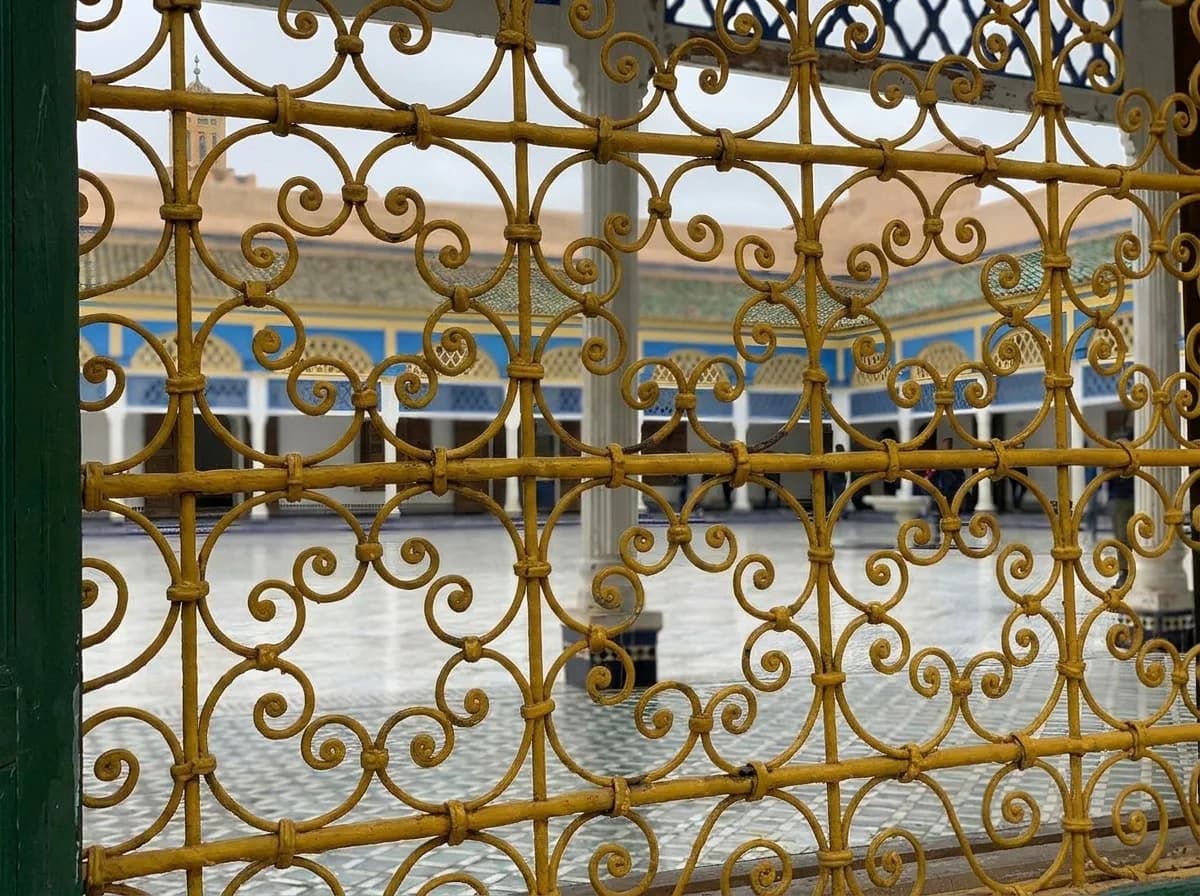
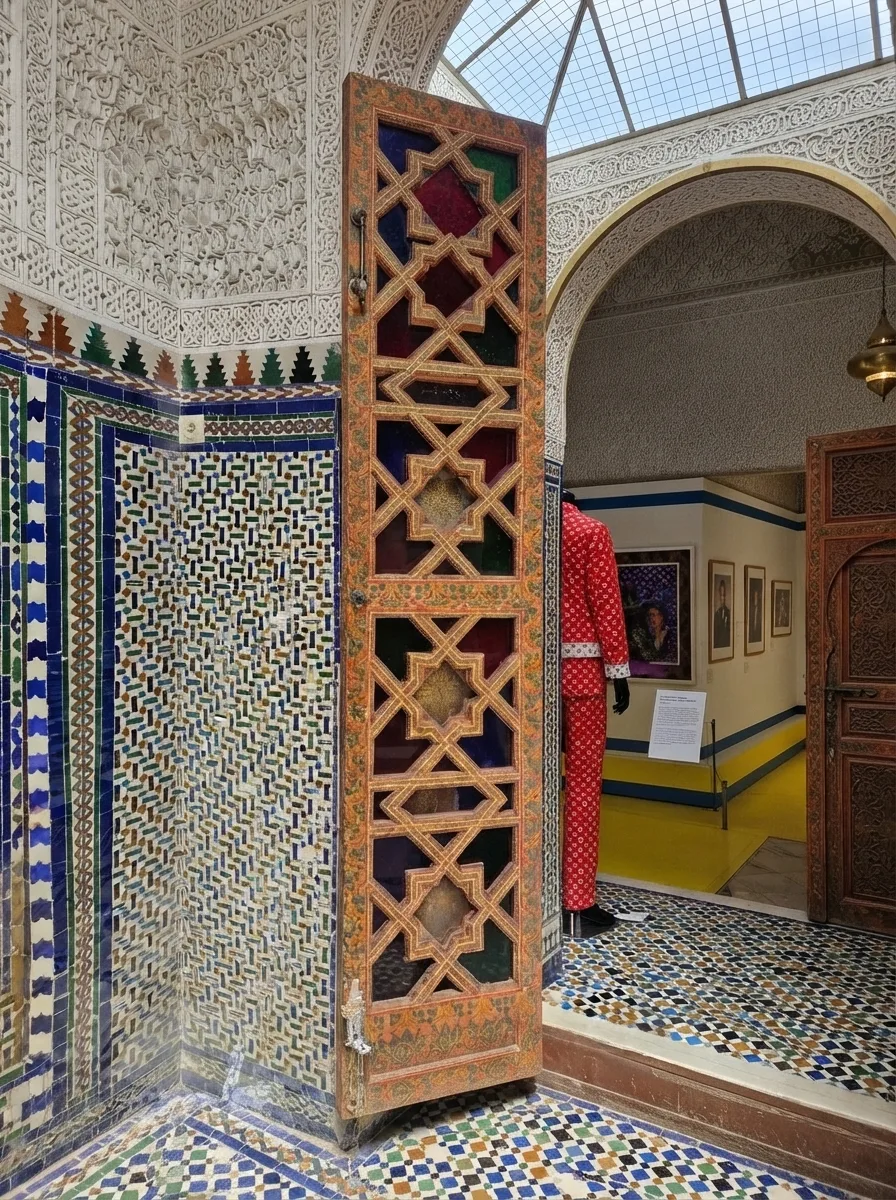
Screens and grilles. Look for the carved wooden lattices and the wrought-iron window grilles, particularly those looking down or across into courtyards. These let women of the household see and hear what was happening in a space without being seen from it. They are one of the clearest surviving pieces of evidence about how the household worked.
Separate circulation. Service corridors, some of them narrow tadelakt passages, let staff move between areas without crossing the formal rooms. Our architecture glossary explains the materials and terms you are looking at.
Walk the palace with that structure in mind and the wandering plan starts to make sense. You are moving from public to private, and the decoration gets more intimate as you go.
Daily life in the private courtyards
We know the shape of the spaces far better than we know what happened in them, so what follows is what the architecture supports rather than a narrative.
The private courtyards are small, planted and centred on water. That combination is deliberate: shade, evaporative cooling and sound. A fountain in a small enclosed courtyard drops the perceived temperature noticeably in a Marrakech summer and masks conversation from adjoining rooms.
Rooms open onto these courtyards rather than onto each other, so the courtyard functions as the circulation space and the living space at once. In practice, life happened in the courtyard and the rooms were for sleeping, storage and retreat from heat or cold.
The apartments in this part of the palace are self-contained units, each with its own courtyard and rooms, of the type called a douiria. A large household with multiple wives and their children would be distributed across several of these rather than sharing one space, which tells you something about how the household was organised: parallel units, not a single communal quarter.
The room-by-room guide covers the sequence you actually walk today.
What the records do not tell us
A short list, because it matters:
- We do not have a reliable count of how many people lived in the household.
- We do not have named biographies for most of the women.
- We do not have first-hand accounts written by them.
- We do not know which specific apartments were occupied by whom.
This is not unusual. Domestic life, and particularly women's domestic life, is under-recorded in the archives of almost every 19th-century elite household anywhere in the world. Bahia is not a special case of secrecy; it is an ordinary case of what history keeps and what it discards.
Guides fill this gap with stories. Some of those stories are plausible. Very few are documented. Enjoy them as folklore and hold them loosely.
What happened after 1900
Ba Ahmed died in 1900, at the height of his power. What followed was fast and brutal.
The palace was stripped. Sultan Abd al-Aziz moved against the household almost immediately and the contents were taken: furnishings, textiles, jewellery, valuables. This is why the rooms you walk through today are empty. It is the single most-asked question at Bahia and the answer is not neglect or slow decline, it is a deliberate emptying within a very short window.
The household itself was dispersed. A vizier's power in this system was personal, not institutional, and when he died it did not transfer to his family. The women and children who had lived behind those screens lost their position along with the building's contents.
Accounts of what happened to individuals afterwards are fragmentary and often contradictory. Our article on who built Bahia Palace covers Ba Ahmed's career and the political mechanics of that collapse in more detail.
Where to see the harem quarters today
The private wings are open, and most visitors walk through them without registering the change.
What to look for:
The scale shift. When the courtyards get smaller and the passages narrow, you have crossed from public to private. Notice it happening.
The screens. Carved wooden lattice panels and iron grilles positioned to look into a courtyard. Stand where a woman of the household would have stood and look through one. It is the most direct connection to the building's social life that survives.
The ceiling quality. In several private rooms the painted cedar is finer and better preserved than in the grand reception halls. Some of that is simply less light and less traffic. Some of it is that this is where the money went.
The small fountains. Each private courtyard has its own water. Listen rather than look.
The 10 hidden details guide points out several specific features in these rooms that are easy to walk past.
One honest caution: there is no signage explaining any of this in situ. You will get considerably more from the private quarters if you have read something beforehand or are using an audio guide. Without context, they read as more empty rooms.
Frequently asked questions
What was the harem at Bahia Palace?
The private family quarter of the palace, where the household's women, children and female servants lived and which men from outside the family did not enter. At Bahia it was not one room but a substantial section with its own courtyards, gardens and self-contained apartments.
Was Bahia Palace named after a woman?
Possibly. "Bahia" means "the brilliant one" or "the beautiful" in Arabic. One tradition holds it was named for a favoured wife of Ba Ahmed; another that it simply describes the palace. The evidence for the first is weak, so treat confident biographical stories about Lalla Bahia as tradition rather than documented history.
Can you visit the harem quarters at Bahia Palace?
Yes. The private wings are part of the standard visitor route. They are not signposted as such, so most visitors pass through without realising the courtyards have become smaller and the decoration more intimate.
How many wives did Ba Ahmed have?
No reliable figure survives in the accessible record, and numbers repeated online are not well sourced. What the architecture suggests is a household organised into several self-contained apartments rather than one shared quarter.
Why are the rooms empty?
The palace was stripped shortly after Ba Ahmed's death in 1900, when the Sultan moved against his household and the contents were removed. The emptiness is the result of a deliberate and rapid seizure, not gradual decay.
What are the wooden screens for?
The carved lattice panels and iron grilles allowed women of the household to see and hear activity in courtyards and reception areas without being visible from them. They are among the clearest surviving physical evidence of how the household separated public and private life.
The private quarters are the part of Bahia Palace most visitors underuse. Entry is the official 100 MAD with no booking fee added, and our ticket page covers what to expect at the gate.