
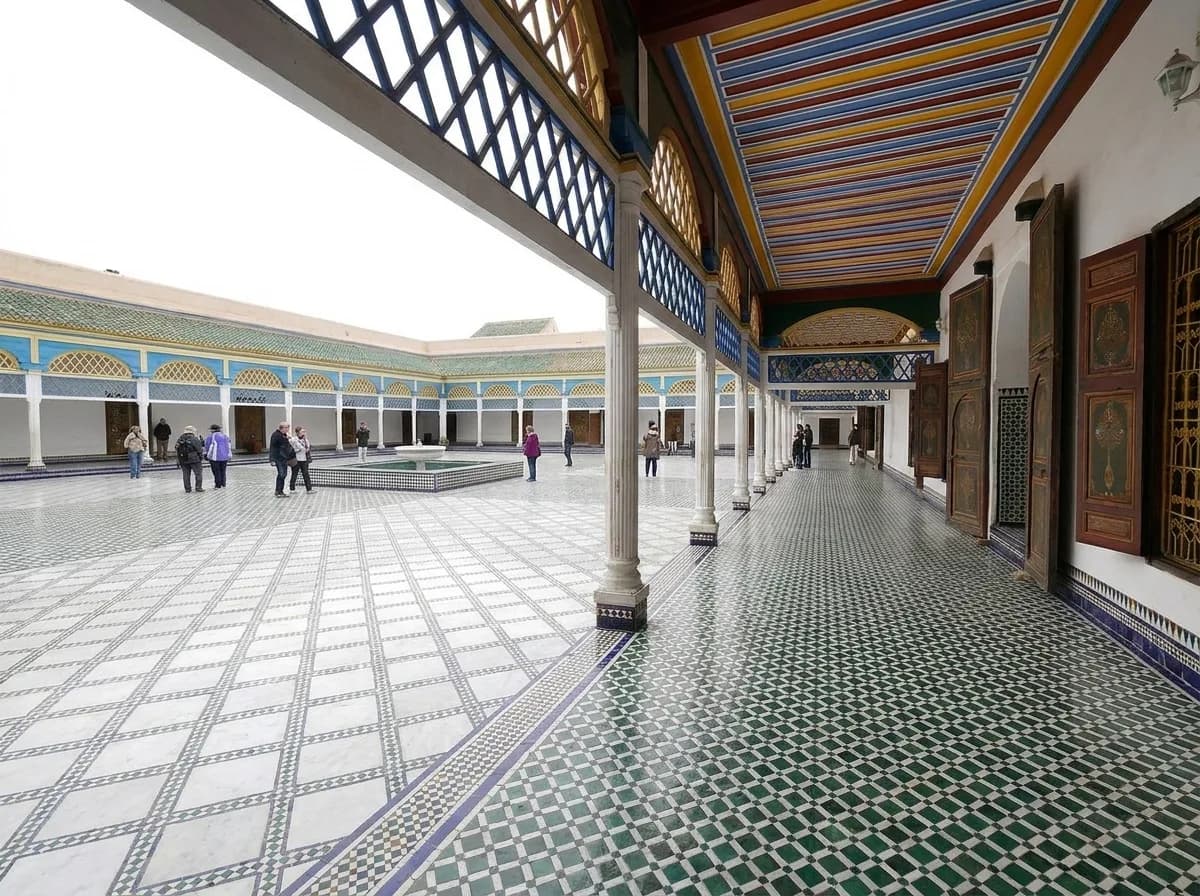
Bahia Palace has one genuine advantage over almost every other monument in Marrakech: it is built on a single level. No staircases between wings, no upper floor, no tower.
It also has uneven centuries-old tile floors, raised thresholds in doorways, gravel garden paths, and no adapted toilet. Getting to the front gate involves either a walk through the medina or a taxi drop-off that is not directly at the entrance.
So the honest answer on Bahia Palace accessibility is: better than most of the medina, and still difficult. This guide covers what you will actually meet, so you can decide before you buy a ticket rather than after.
Is Bahia Palace wheelchair accessible?
Partially. A wheelchair user can see a meaningful portion of the palace, including the main courtyards, with assistance. Independent access throughout is not realistic.
The specifics:
In your favour: the palace is single-level across roughly 8,000 m². Once inside, moving between the major courtyards does not require stairs. Doorways are generally wide, because they were built for a household of some ceremony. The main routes are broad enough for a wheelchair to turn.
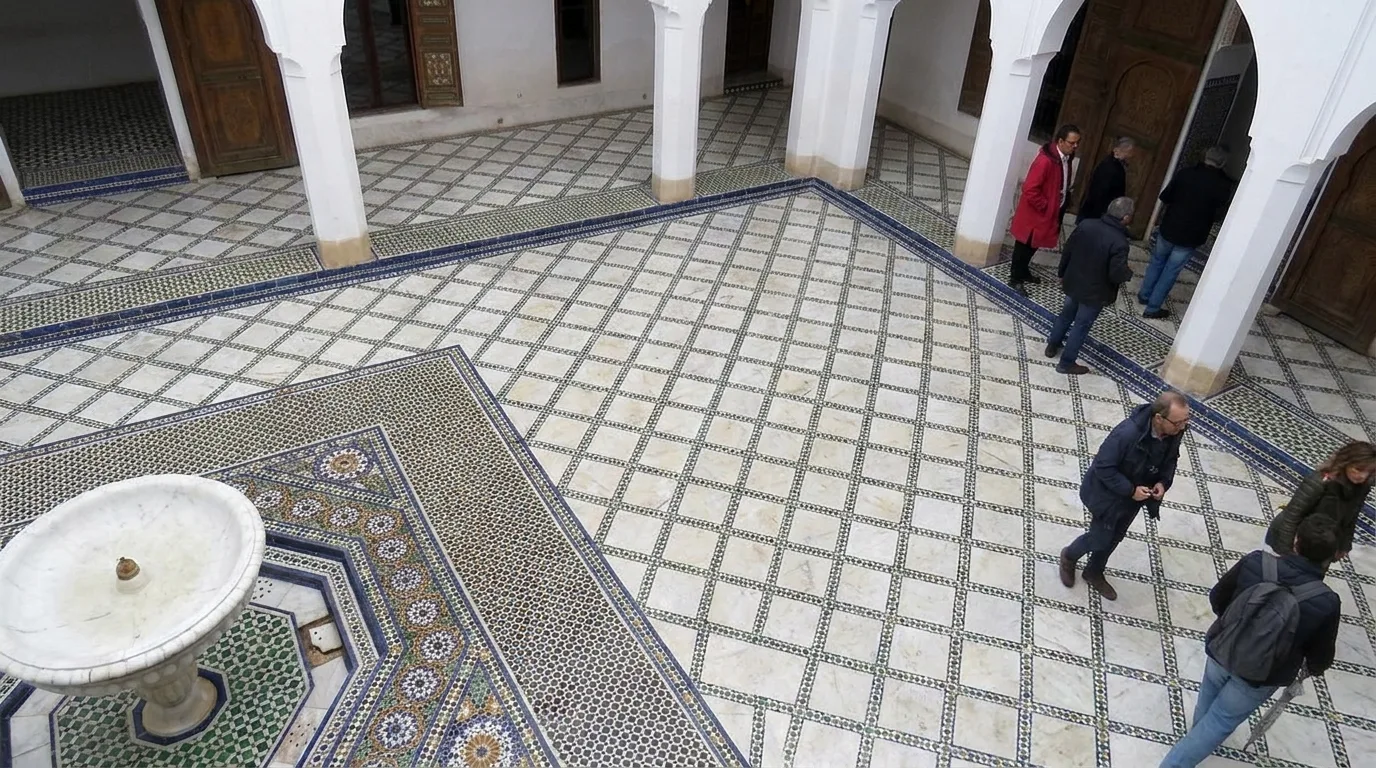
Against you: the floors are original zellige and stone, which means slightly uneven surfaces, occasional lipped joints, and polished tile that can be slick. Several doorways have a raised threshold, typically a step of a few centimetres, sometimes more. Garden paths are compacted earth and gravel rather than smooth paving. There are no ramps at the thresholds.
A manual wheelchair with a companion who can tip and lift over thresholds will manage the main sequence. A heavy powered chair will struggle at some doorways and on the garden paths.
The single-level advantage, in context
It is worth understanding how unusual this is locally, because it may change which monuments you prioritise.
Most historic buildings in the medina are multi-level with narrow stone stairs and no lift. Dar Si Said has an upper floor. Ben Youssef Madrasa has student cells upstairs, though the main courtyard is at ground level. El Badi involves ramps, ruins and uneven ground across a large site.
If mobility is your main constraint and you are choosing one monument, Bahia is a defensible choice on those grounds alone. Our comparison with El Badi covers the terrain difference between the two in more detail.
Where the surfaces get difficult
Three specific places to expect trouble:
Thresholds between rooms. The palace is a sequence of separate buildings joined together, and many of the joins have a raised sill. Most are small. A few are a genuine step. This is the single most common obstacle inside.
The garden courtyards. Paths through the riad gardens are compacted earth, sometimes with loose gravel and occasional tree roots. Passable with effort in a manual chair; unpleasant in a powered one; a real trip hazard for anyone unsteady on their feet.
Polished zellige after cleaning. The tiled floors are washed, and wet glazed tile is slippery. If you visit early in the morning you may hit floors that have just been mopped. Anyone using a stick or crutch should take this seriously.
Steps, doorways and getting through the sequence
There is no single accessible route marked at the palace, and staff are not trained to guide you along one. In practice this means arriving with a plan of your own.
The main courtyards, which are what most visitors come for, are the flattest and most open part of the building. The private apartments involve more thresholds. The far garden wings involve the roughest ground.
A reasonable approach for a visitor with limited mobility is to see the grand courtyard, the main reception rooms and one garden, then stop. That is perhaps 60% of what the palace offers visually and it avoids the worst of the terrain. Our room-by-room guide lets you pick which rooms matter most to you in advance.
Toilets
There are no adapted toilets at Bahia Palace.
This is the point where a fair number of visitors decide to change their plans, so it is worth stating plainly rather than burying. Facilities at the palace are basic. If accessible toilet access is a requirement for you, plan around it: use facilities at your riad before you leave, keep the visit to 60 to 90 minutes, and identify a café nearby in advance.
Getting there: taxi drop-off versus walking
This is often harder than the palace itself.
Bahia Palace sits on Rue Riad Zitoun el Jedid inside the medina. The medina is largely pedestrian, so a taxi cannot pull up at the entrance. Drivers will drop you at the nearest accessible point, and from there you have a short walk on medina paving, which is uneven, sometimes narrow, and shared with mopeds.
Practical notes:
- Ask your riad to book a taxi and to tell the driver specifically where to drop you for Bahia Palace. The nearest drop-off points are known locally.
- Expect somewhere between 100 and 400 metres of medina walking from the drop-off, depending on where the driver stops and how congested the lanes are.
- Mopeds use these lanes. They will go around you, but they are quiet until they are close, which is disconcerting if you are slow-moving.
- Avoid the walk from Jemaa el-Fna if mobility is a concern. It is roughly ten minutes for an able-bodied walker and considerably longer over difficult surfaces. Our directions guide describes the route.
Strollers and young children
Much of the above applies to pushchairs, with one difference: you can lift a stroller over a threshold easily, and you can fold it.
A lightweight, narrow stroller works. A large three-wheeler is awkward in the doorways and in the taxi. A baby carrier is comfortably the easiest option and is what most experienced parents use in the medina.
The single-level layout is a real benefit with small children, and the courtyards give them room to move without being anywhere near a drop or a road. Our family guide to Bahia Palace covers timing, shade and how long children actually last.
Elderly and limited-mobility visitors
If you are walking unaided but slowly, Bahia is manageable with three adjustments:
Go early. Arriving at opening means cooler air and fewer people to navigate around. The best time to visit guide has the hourly pattern.
Plan to sit. There is limited formal seating. The garden courtyards have low walls and shaded edges where sitting is tolerated. Knowing that in advance is better than looking for a bench that is not there.
Cut the visit short deliberately. Ninety minutes on uneven stone is a lot. Sixty minutes seeing the best three courtyards beats two hours of exhaustion, and you will remember it more fondly.
Heat is the other factor. The courtyards are open to the sky. Between June and September, an afternoon visit is genuinely hard on anyone with a cardiac or respiratory condition. Our tips before visiting covers heat management.
Would a guide help?
Yes, more than you might expect, and for a practical reason rather than a historical one.
A guide who knows the building can route you around the worst thresholds and tell you which wing is not worth the effort today. They can also handle the entrance process while you wait somewhere comfortable. If you go this route, make your requirements explicit when booking. Our guided tour guide covers the options and typical prices.
An audio guide is the cheaper alternative and lets you set your own pace, which for many visitors with limited mobility is the more important factor.
Frequently asked questions
Is Bahia Palace wheelchair accessible?
Partially. The palace is single-level with wide doorways and no internal stairs, which helps considerably. However, floors are uneven original tile, several doorways have raised thresholds without ramps, and garden paths are gravel. A manual chair with an assistant can see the main courtyards.
Are there adapted toilets at Bahia Palace?
No. Facilities are basic and there is no adapted toilet. Plan to use facilities at your accommodation before visiting and keep the visit to around 60 to 90 minutes.
Can a taxi drop me at the entrance?
No. Bahia Palace is inside the pedestrian medina, so taxis stop at the nearest vehicle-accessible point. Expect roughly 100 to 400 metres of walking on medina paving. Ask your riad to instruct the driver where to stop.
Is Bahia Palace suitable for elderly visitors?
Generally yes, with planning. The lack of stairs is a genuine advantage over other Marrakech monuments. Go early to avoid heat and crowds, expect uneven surfaces, and plan a shorter visit of around an hour rather than a full circuit.
Can I take a stroller into Bahia Palace?
Yes. A narrow, lightweight, foldable stroller works best because of the raised thresholds. Many parents find a baby carrier easier both inside the palace and on the walk through the medina.
Is there anywhere to sit inside?
Formal seating is limited. The garden courtyards have low walls and shaded edges where visitors sit. If you need to rest regularly, plan your route around the gardens rather than the interior rooms.
If Bahia Palace is the monument you choose, entry is 100 MAD at the official rate with no booking fee added. Our ticket page sets out how entry works so there are fewer surprises at the gate.